Understanding the Relationship Between State and Federal Governments in the U.S.
This comprehensive exploration delves into the intricate relationship between state and federal governments in the United States, highlighting their similarities, differences, and power dynamics. We examine the advantages of a federal system versus a centralized government, as seen in other nations. Additionally, we discuss the founding principles that led to the establishment of federalism, the types of laws created at both levels, and the potential consequences if states attempt to override federal legislation. Real-world examples will illustrate the conflicts arising from this division of power.

Understanding the Relationship Between State and Federal Governments in the U.S.
E N D
Presentation Transcript
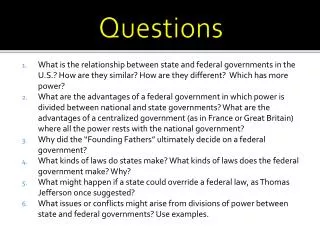
Questions • What is the relationship between state and federal governments in the U.S.? How are they similar? How are they different? Which has more power? • What are the advantages of a federal government in which power is divided between national and state governments? What are the advantages of a centralized government (as in France or Great Britain) where all the power rests with the national government? • Why did the “Founding Fathers” ultimately decide on a federal government? • What kinds of laws do states make? What kinds of laws does the federal government make? Why? • What might happen if a state could override a federal law, as Thomas Jefferson once suggested? • What issues or conflicts might arise from divisions of power between state and federal governments? Use examples.