Understanding Earth's Climate Dynamics: Discoveries and Implications
Gain insights into Earth's climate system, from temperature determinants to feedback processes impacting climate change. Explore factors like solar energy, greenhouse gases, and aerosols. Discover the sensitivity of the climate system to various forcings and responses. Learn from past climate variations and understand the complex interplay of positive and negative feedback mechanisms.


Understanding Earth's Climate Dynamics: Discoveries and Implications
E N D
Presentation Transcript
Earth’s Climate SystemWhat have we learned? • Earth is a planet • Planetary temperature is determined by • Brightness of our star • Earth-sun distance • Albedo of the planet • Composition of Earth’s atmosphere Energy In = Energy Out So how can climate ever change?
Earth’s Climate SystemWhat have we learned? • Earth’s overall temperature is determined by sunshine and albedo (-18 C) • Temperature varies dramatically with height because of greenhouse effect! • Surface temperature is much warmer (+15 C) than planetary radiation temp O C O O H H Molecules that have many ways to wiggle are called “Greenhouse” molecules
Earth’s Energy BudgetWhat have we learned? Surface climate depends on heating • 51 units of absorbed solar • 96 units of downward infrared (almost 2x sunshine)! Surface climate depends on cooling • 117 units of upward infrared • 23 units of evaporation, 7 units of rising thermals
Earth’s Climate as a “Black Box” S0 TS Climate System 1367W m-2 15 C Surface Temperature Out Sunshine In
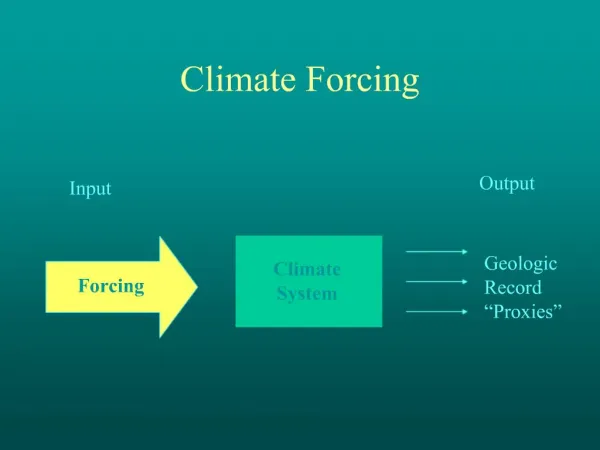
Climate Forcing, Response, and Sensitivity DS0 DTS Climate System + 1W m-2 ? °C Response: (Change in Surface Temperature) Forcing (change in sunshine)
Climate Forcing, Response, and Sensitivity Forcing (change in sunshine) Response: (Change in Surface Temperature) “Let’s do the math …” A 1 W m-2 change in sunshine would produce about a 0.26 °C change in planet’s temperature
DTS Dvapor D albedo Climate Feedback Processes • Positive Feedbacks (amplify changes) • Water vapor • Ice-albedo • High clouds D hi cloud D LW D lo cloud DS • Negative feedbacks (damp changes) • Longwave cooling • Low clouds
Estimating Total Climate Sensitivity • At the Last Glacial Maximum (~ 18k years ago) surface temp ~ 5 K colder • CO2 was ~ 180 ppm (weaker greenhouse, 3.7 W m-2 more OLR) • Brighter surface due to snow and ice, estimate 3.4 W m-2 more reflected solar Almost 3x as sensitive as suggested by Stefan-Boltzmann alone … Other feedbacks must be going on as well
Our Variable Star • Changes of ~ 0.2% (= 2.7 W m-2) reflect 11-year sunspot cycle
Cycle of Solar Variability • 11 Year Cycle of Magnetic Disturbances • Active sun is ~ 0.1 % brighter than quiet sun
BOOM! • Volcanos release huge amounts of SO2 gas and heat • SO2 oxidizes to SO4 aerosol and penetrates to stratosphere • SO4 aerosol interacts with solar radiation Mt. Pinatubo, 1991
Aerosol-Cloud Albedo Feedback • Ship tracks off west coast • Aerosol serves as CCN • Makes more/smaller cloud drops • Higher albedo
Greehouse Radiative Forcing • Note different scales • Modern changes comparable to postglacial, but much faster!