Understanding Protein Synthesis: From DNA Transcription to Translation Process
510 likes | 638 Views
This overview explains the essential processes of protein synthesis, starting from DNA transcription to RNA translation. It highlights the roles of the three types of RNA: mRNA, tRNA, and rRNA, as well as the importance of codons and anticodons in translating genetic information into proteins. Key differences between DNA and RNA are outlined, along with how mutations can impact protein synthesis and lead to various genetic conditions. This process is crucial for understanding gene expression and its implications for traits in living organisms.


Understanding Protein Synthesis: From DNA Transcription to Translation Process
E N D
Presentation Transcript
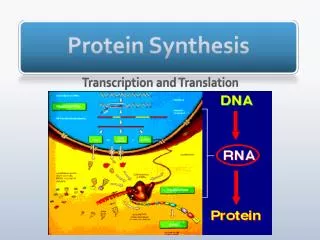
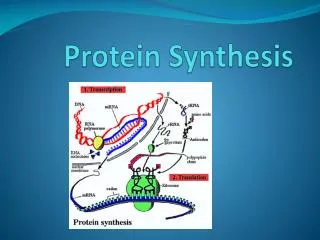
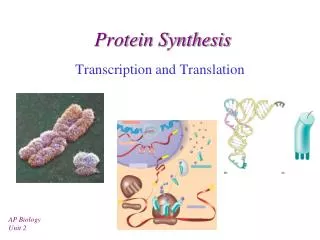
DNA TRANSCRIPTION RNA TRANSLATION PROTEIN
Gene DNA Protein Trait
Phosphate Group O O=P-O O Nitrogenous base (A, U,G, C ) 5 CH2 O N Sugar (ribose) C1 C4 C3 C2 RNA
RNA • Function: obtain information from DNA & synthesizes proteins
3 differences from DNA • Single strand instead of double strand • Ribose instead of deoxyribose • Uracil instead of thymine
3 types of RNA • Messenger RNA(mRNA)- copies information from DNA for protein synthesis Codon-3 base pairs that code for a single amino acid. codon
3 types of RNA 2.Transfer RNA(tRNA)- carries amino acids to the ribosomes for protein synthesis Anticodon-a sequence of 3 bases that are complementary base pairs to a codon in the mRNA
3 types of RNA 3. Ribosomal RNA(rRNA)- where the aa’s are put together to make a protein
Amino Acids • Amino acids-the building blocks of protein • At least one kind of tRNA is present for each of the 20 amino acids used in proteinsynthesis.
Transcription - mRNA is made from DNA & goes to the ribosome Translation- Proteins are made from the message on the mRNA
Transcription • In order for cells to make proteins, the DNA code must be transcribed (copied) to mRNA. • The mRNA carries the code from the nucleus to the ribosomes.
TRANSCRIPTION PRACTICE • AGG CCT GCT TEMPLATE • TCC GGA CGA NON- TEMPLATE • mRNA (CODONS) • UCC GGA CGA
TGG CAG CTA DNA • ACC GUC GAU TRANSCRIPTION (mRNA)
Translation • At the ribosome, amino acids (AA) are linked together to form specific proteins. • The amino acid sequence is directed by the mRNA molecule. Amino acids ribosome
Make A Protein • DNA sequence ATG AAA AAC AAG GTA TAG • mRNA sequence UAC UUU UUG UUC CAU AUC
Make mRNA • mRNA sequence UAC UUU UUG UUC CAU AUC • tRNA sequence AUG AAA AAC AAG GUA UAG
Make mRNA • mRNA sequence UAC UUU UUG UUC CAU AUC Amino Acid sequence TYR PHE LEU PHE HIS ILE
Early evidence indicating most genes specify the structure of proteins • Garrod’s work on inborn errors of metabolism in early 1900s • Beadle and Tatum’s work with Neurospora mutants in the 1940s
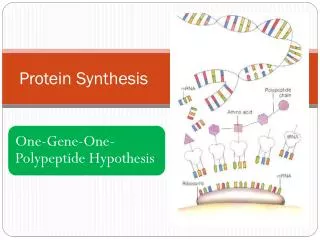
Information flow from DNA to protein • Transcription • RNA molecule complementary to the template DNA strand synthesized • Translation • Polypeptide chain specified by messenger RNA (mRNA) is synthesized
Coupled transcription and translation in bacteria • Unlike eukaryotic cells, in bacterial cells translation and transcription coupled • Translation of the bacterial mRNA molecule usually begins before the 3´ end of the transcript is completed
Retroviruses • Flow of genetic information is reversed by reverse transcriptase • Enzyme associated with retroviruses • Retroviruses synthesize DNA from an RNA template • Example of retrovirus is HIV-1, AIDS virus
Mutations • Base substitution mutations • Often result from errors in base pairing during replication • Missense mutations • Nonsense mutations • Frameshift mutations • One or two nucleotide pairs are inserted into or deleted from the molecule
Some mutations involve larger DNA segments • Due to change in chromosome structure • Wide range of effects as they involve many genes • DNA sequences that “jump” into the middle of a gene • Known as transposons or transposable genetic elements • Most are retrotransposons
Mutations • What causes mutations? • Can occur spontaneously • Can be caused by a mutagen • Mutagen:An agent, such as a chemical, ultraviolet light, or a radioactive element, that can induce or increase the frequency of mutation in an organism.
Mutations • Some mutations can: • Have little to no effect • Be beneficial (produce organisms that are better suited to their environments) • Be deleterious (harmful)
Mutations • Types of mutations • Point Mutations or Substitutions: causes the replacement of a single base nucleotide with another nucleotide • Missense- code for a different amino acid • Nonsense- code for a stop, which can shorten the protein • Silent- code for the same amino acid (AA)
THE FAT CAT ATE THE RAT • THE FAC CAT ATE THE RAT
Mutations • Example: Sickle Cell Anemia
Mutations • Types of mutations • Frame Shift Mutations: the number of nucleotides inserted or deleted is not a multiple of three, so that every codon beyond the point of insertion or deletion is read incorrectly during translation. • Ex.: Crohn’s disease
THE FAT CAT ATE THE RAT • THE FAC ATA TET HER AT • THE FATT CAT ATE THE RAT • THE FAT TCA TAT ETH ERA T
Mutations • Types of mutations • Chromosomal Inversions: an entire section of DNA is reversed. • Ex.: hemophilia, a bleeding disorder
DNA Repair • A complex system of enzymes, active in the G2 stage of interphase, serves as a back up to repair damaged DNA before it is dispersed into new cells during mitosis.