Download
1 / 19
210 likes | 346 Views
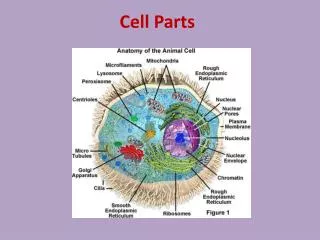
This overview explores the fundamental components of cells, focusing on the plasma membrane's vital role in regulating material exchange essential for maintaining homeostasis. The structure of the plasma membrane is a phospholipid bilayer that exhibits selective permeability, allowing specific molecules to enter and exit the cell. We also examine the nucleus as the control center housing genetic material, as well as various organelles such as ribosomes, endoplasmic reticulum, Golgi apparatus, vacuoles, lysosomes, and mitochondria. Each structure plays a crucial role in cellular processes and energy management.

E N D
Cell Parts Dissecting the cell
Plasma Membrane • Cells must control the materials that enter and leave. • The PM is the boundary between the cell and it’s environment.
Homeostasis • Homeostasis is the process of maintaining the cell’s environment. • Selective permeability is the process where a cell allows some molecules into the cell and not others.
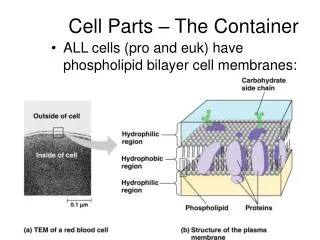
PM Structure • PM is made of a phospholipid bilayer • Two phospholipid layers • Hydrophilic – “likes” water • Hydrophobic – “afraid” of water
Cytoplasm • Thick jelly-like substance that fills the cell • Allows material to be moved around the cell.
Control Center The Nucleus
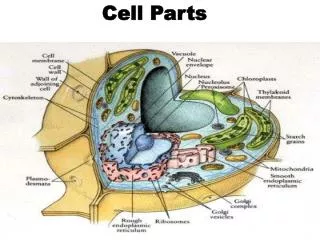
Nucleus • The nucleus contains the genetic material for the cell • Chromosomes • Nuclear Envelope • Double membrane • Nuclear pores
Chromosomes • Chromosomes are made of DNA. • DNA is the genetic material that holds all the information in the organism. • Located inside the nucleus
Homework • Organelle Summary Sheet • Flashcards
Assembly, Transport & Storage Other organelles
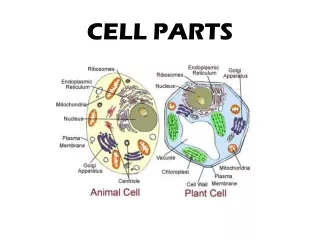
Ribosomes • Ribosomes control protein synthesis • Made by the nucleolus • Found floating freely in the cytoplasm or on the rough endoplasmic reticulum
Endoplasmic Reticulum • Site of chemical reactions in the cells • Rough ER • Covered in ribosomes • Smooth ER • No ribosomes
Golgi Apparatus • Sorts and packages products of the ER • Sends packaged proteins to various locations around the cell • Uses vesicles as packaging
Vacuoles & Lysosomes • Vacuoles are used in temporary storage of materials • Plant cells have one large vacuole while animal cells have many smaller vacuoles • Lysosomes contain digestive enzymes that break apart cellular waste for re-use
Cellular Energy Mitochondria
Mitochondria • Energy powerhouses for the cell • Found in plant and animal cells • Double membrane • Increased surface area for reactions
Cytoskeleton • Interior network of support in cells • Criss-crossed web of small “support beams” • Microtubules • Microfilaments
Homework • Organelle Summary Sheet • Flashcards