Enhancing Learning Through Diverse Activity Selection: Strategies for Engagement
In today's fast-paced learning environments, retaining attention is a challenge. On average, adults can listen effectively for only about 10 minutes. To foster engagement, it's essential to build active learning techniques and vary activities. Incorporate both divergent and convergent activities, such as brainstorming and decision-making, and utilize multiple modalities—ranging from visual to kinesthetic. This guide explores various approaches, including action learning, coaching, and simulations, to create dynamic training experiences that cater to diverse learning styles and promote knowledge retention.

Enhancing Learning Through Diverse Activity Selection: Strategies for Engagement
E N D
Presentation Transcript
Selecting Learning Activities Think About Your Options
How to Select Activities • http://www.nwlink.com/~donclark/hrd/media.gif
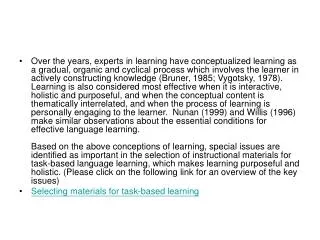
The Currency of Attention • The average adult can sit and listen for about 10 minutes • Build active learning techniques to improve and retain attention • Vary your activities • Consider divergent and convergent • Use different modalities
Linguistic-verbal Logical-mathematical Visual-spatial Bodily-kinesthetic Musical-rhythmic Interpersonal Intrapersonal Naturalist Learners are Individuals! When choosing activities, consider the full range of “multiple intelligences” - Howard Gardner http://www.ed.psu.edu/insys/ESD/gardner/menu.html
Convergent & Divergent Processes • Divergent: activities which open up actions and ideas and do not require agreement or decision making. Example: brainstorming. • Convergent: activities which ask groups to move towards a shared outcome or goal. Example: prioritization and decision making. These generally require more process. • Mix the two styles!
Example Approaches • Action Learning - action + reflection - extends learning outside the training room • Action Research - research + action + reflection – extends learning • Appreciative Inquiry - asset based • Assessment-Based Learning Activities – tests, quizes and audits
More Approaches • Brainstorming – divergent, no bad ideas! • Case Studies – real world examples • Coaching - individual performance feedback • Consensus, Rating, Decision Making Activities - convergent
More Approaches • Debriefing Activities - (AAR, 3 Questions) interim and final review • Fishbowls - http://www.nwlink.com/~donclark/hrd/learning/fishbowls.html • Future Visioning – planning, opening up possibilities • Lecture – keep it short!
Games • Icebreakers – introductions, create comfort • Energizers – physical and mental “refreshment” • Content Focused Games – games designed to support the learning goals • See http://www.deepfun.com, http://www.nasaga.org and http://www.thiagi.com
Performance Type Activities • Improvisation – supports creativity, flexibility • Question and Answer – use adults expertise • Skits – kinesthetic and visual • Role Play – experience different perspectives • Simulations – practice in a safe environment
Example Activities • Questions for Another Group (peer learning) • How to Use this at Work? (relevance) • Case Studies With Questions (exemplars) • Stump the Trainer (gauge group knowledge) • Turn to Your Neighbor (large group/small conversation) • Quick Quiz (5-6 questions, group or individ.)
Examples • Two Truths & a Lie: Can be an icebreaker or review activity • Crumpled Question Toss: review, knowledge sharing • Each One Teach One
Use/Tell/Different • What is one thing you will use (tomorrow, soon, next week)? • What is one thing you will tell others (colleagues, stakeholders, etc) about? • What one thing you would improve the next time?
More Activities • Fill in the Blanks (blanks in handouts) • Crossword Puzzle (content focused training) • Find the Question/Find the Answer (prepared cards, group activity, movement) • You Read It/You Teach It (for non technical content)
More Training Technique & Activity Resources • Summary of Training Techniques – http://www.inquiry.net/adult/trainer/techniques.htm • Thiagi’s Interactive Strategies for Improving Performance - http://www.thiagi.com/ws-interactive-strategies-for-improving-performance.html
Icebreaker Resources • Don Clark’s Icebreakers - http://www.nwlink.com/~donclark/leader/icebreak.html • http://www.bbyo.org/bbg/ideas/mixers.html • Introduction Icebreakers - http://honolulu.hawaii.edu/intranet/committees/FacDevCom/guidebk/teachtip/breakice.htm • http://www.openconcept.ca/index.php/Facilitation/31 & http://www.openconcept.ca/index.php/Facilitation/30 • http://www.topten.org/content/tt.AU20.htm • http://www.resultsthroughtraining.com/downloads/Icebreakers.HTML
Energizer Resources • http://www.johnsleigh.com.au/energizers.htm • http://www.energizeinc.com/art/aget.html • http://www.zhaba.cz/materials/misc/energizers.html • http://www.jef-europe.net/infopool/files/IPSEM8.doc