Understanding Vertebrates: An Overview of Animal Classification
Animals can be classified into two primary groups: vertebrates, which have backbones, and invertebrates, which do not. The world is home to over 50,000 vertebrate species, including humans, birds, and whales. Vertebrates are categorized into seven classes: bony fish, cartilaginous fish, jawless fish, amphibians, reptiles, birds, and mammals. Each class exhibits distinct features, such as lungs in amphibians, feathers in birds, and the ability to produce milk in mammals. Invertebrates also comprise numerous species, showcasing the diversity of life on Earth.

Understanding Vertebrates: An Overview of Animal Classification
E N D
Presentation Transcript
Classifying Animals Vertebrates Chap. 3, lesson 2, pages 51-65
Animals divided into 2 groups • Vertebrates • These are animals with backbones. • Over 50,000 species of vertebrates in world • Some examples are: • humans • hummingbirds • Blue whales • Invertebrates • These are animals without ___________. • Over _________ species of invertebrates in world. • Some examples are: • _______________ • ________________ • ________________
Vertebrates have 3 special features: Internal skeleton skull backbone
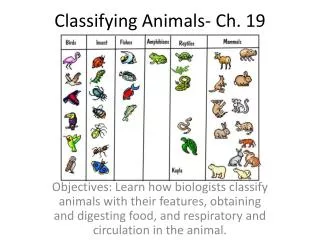
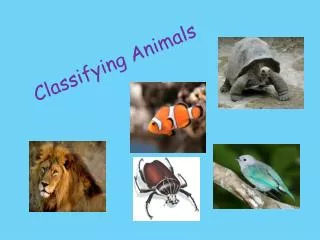
Vertebrate are divided into 7 classes: • Fish with bones (bass, trout, salmon) • Fish with cartilage (sharks, skates, rays) • Fish without jaws or scales (lampreys, hagfish) • Amphibians • Reptiles • Birds • mammals
There are about 24,000 species of fish in the world. • All fish live in water and breathe with their gills. • Most fish have skeleton of bones. • Ex: bass, trout, salmon • Bony fish covered in scales • Bony fish have swim bladder that help them move up and down in water. • Cold-blooded • Some fish have cartilage instead of bone. • They have powerful jaws and sharp teeth. • Ex: sharks, skates, rays
amphibians=“_______________” • Over 5,000 species of frogs, toads, + salamanders. • Live part of life on land, and part in water. • Adult amphibians breathe with lungs or through their skin which is thin and moist. • Cold-blooded • Tadpoles to frogs Tadpole live in water, Then grows legs, loses gills and tail, develops into frog. Frog lives on land. This is called Metamorphosis.
Reptiles • Ex: snakes, lizards, turtles, alligators, crocodiles. • About 7,000 species. • Some live in water, some on land. • Skin is scaly and watertight. • Most lay eggs on land, and the egg is soft. • Reptiles breathe with lungs. • Cold-blooded which means their body temp. changes with their surroundings.
Birds • More than 9,000 species. • Almost all can fly-except • Ostrich ----emu ---penguins • Feathers keep birds warm, provide lift for flying, and smooth their body.
Birds cont. • Have hollow bones that make it easy to fly. • Need to eat constantly because they burn up so much energy flying. • Breathe with lungs. • Lay eggs have hard shell • Birds are • warm-blooded. • This means that no matter what the temperature is inside or outside, their body temperature stays the same.
Mammals • Named for the mammary gland which produces milk for their babies. • Mammals nurse their babies. • Most mammals have hair that covers body • Most live on land, but some in water, ex: • Whales, porpoises, dolphins
Mammals cont. • All have lungs and breathe air. • Most mammals birth live babies. -bears -elephants -mice -humans • Some have babies inside a pouch, like • Opossums • kangaroos • Only a couple lay eggs, such as • Duck-billed platypus\ • Spiny anteater
What three features do all vertebrate have? • 1. • 2. • 3. • How does a trout’s skeleton differ from a shark’s skeleton? • What happens during metamorphosis in a frog? • Why are a frog’s eggs able to survive in dry places? • What 2 features do mammals have that other vertebrates do not have?