Understanding Aspects and Concerns in Product Line Engineering: A Modular Approach
60 likes | 184 Views
This discussion explores the intricacies of aspect-oriented programming and concern identification within Product Line Engineering (PLE). It delves into the types of concerns, cross-cutting concerns, and the impact of late identification on modularization. The text provides insights into effective strategies for early separation of concerns to minimize issues related to incorrect decomposition. Additionally, it examines existing methods for identifying cross-cutting concerns and highlights challenges associated with various decomposition techniques. The conclusion emphasizes the significance of these aspects in enhancing visibility and commonalities in PLE.


Understanding Aspects and Concerns in Product Line Engineering: A Modular Approach
E N D
Presentation Transcript
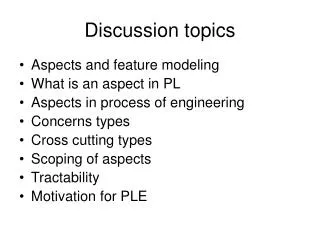
Discussion topics • Aspects and feature modeling • What is an aspect in PL • Aspects in process of engineering • Concerns types • Cross cutting types • Scoping of aspects • Tractability • Motivation for PLE
Identifying Concernsin PL • Motivation • Problems with late identification of concerns • Incorrect or incomplete decomposition • How to minimize dealing with cross-cutting concerns • early separation of concerns • CC derives by • Nature of application domain • Modularization criteria • Problems inherent in the techniques for decomposition of domain (e.g., object-oriented, functional decomposition, etc.) • Specific modularization • End result of using the modularization criteria
Related works • EA group • Tar, et al HyperJ MD-SOC
Future Works • Methods to identify/predict • Criteria to identify/tag CC • Identify similarity in domain knowledge base • Functional • Organization • Regulation • Any known patterns • Analyze variants • Where CC appear – where to look for CC
Solutions • Development of domain anthology • Analyze patterns of similarities – meta-domain analysis • NFR main candidate for CC • Same realization for same concerns in similar PL
Conclusions • Identifying of EA can use to capture commonalities and visibilities in PL?