Cross-Platform C++ Signal Processing Development with VSIPL and API Extensibility
This document discusses the portability and architecture independence of signal processing applications developed in C++ across various operating systems, including Solaris, Linux, VxWorks, macOS, and Windows. It highlights the reusability of coded algorithms, with examples showing how development time can be drastically reduced from months to weeks. The text also explores the powerful expressibility of the C++ Math API, using code snippets to demonstrate operations. Memory management principles are outlined alongside performance profiling and debugging methods, making it suitable for robust signal processing applications.

Cross-Platform C++ Signal Processing Development with VSIPL and API Extensibility
E N D
Presentation Transcript
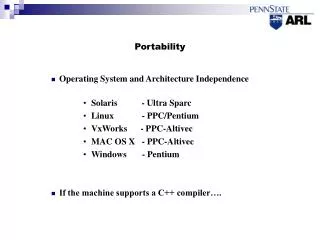
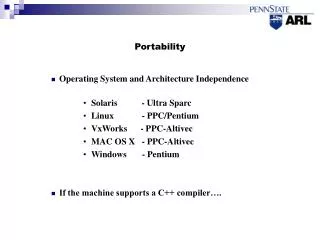
Portability • Operating System and Architecture Independence • Solaris - Ultra Sparc • Linux - PPC/Pentium • VxWorks - PPC-Altivec • MAC OS X - PPC-Altivec • Windows - Pentium • If the machine supports a C++ compiler….
Reusability • First signal processing application -- 6 months development • Second (comparable) application -- 6 weeks development • Original development of second application in ADA - minimum of 6 months. Application A Application B Application C C++ Math API C VSIPL Interface VSIPL library
Rapid/Stable Applications Development Powerful Expressibility: D = C / 2.0 - A + B * A; A = B ^ 3.5; A = B.abs(); A = B.sin(); A = B.var(); A = B.fft().fftshift().abs(); // A = abs(fftshift(fft(B))); A = (B.fft() * (C.fft().conj())).ifft(); A = B.xcorr(C ); Memory Management: most dynamic memory usage, including VSIPL, is transparent
SharedObjects • Signal processing objects are generated once and are automatically shared: • FFT coefficients • Window Functions • Filters • Tuners
Standard Template Library • The C++ STL containers provide an efficient means to organize, access, and process information/data. • Most modern large-scale C++ signal processing development efforts will use the STL extensively. • The math API interface can be made to mirror STL operation to provide a more intuitive use of basic API operations.
Extensibility Inherit most functionality, modify some, add other functions Applications Extended C++ Math API This could be Company Proprietary C++ Math API This could be unlimited distribution C VSIPL Interface VSIPL library
VSIPL Transparency …. Memory Management • VSIPL codelet to perform A = B * C for vectors of 512 samples float_complex A[512], B[512], C[512]; // data must be placed in B and C vsip_cblock_f *Ab, *Bb, *Cb; vsip_cvview_f *Av, *Bv, *Cv; // must bind user data to blocks Ab = vsip_cblockbind_f(A, 0, 512, 0); // omitting error checking Bb = vsip_cblockbind_f(B, 0, 512, 0); Cb = vsip_cblockbind_f(C, 0, 512, 0); // must create view to blocks Av = vsip_cvbind_f(Ab, 0, 1, 512); // omitting error checking Bv = vsip_cvbind_f(Bb, 0, 1, 512); Cv = vsip_cvbind_f(Cb, 0, 1, 512);
VSIPL Transparency …. Memory Management (cont) • VSIPL codelet to perform A = B * C for vectors of 512 samples (cont) // must admit blocks to VSIPL memory space vsip_cblockadmit_f(Ab, 0); // omitting error checking vsip_cblockadmit_f(Bb, 0); vsip_cblockadmit_f(Cb, 0); // finally, we get to the multiply vsip_vmul_f(Bv, Cv, Av); // must destroy blocks, views, etc: vsip_cvalldestroy_f(Av); vsip_cvalldestroy_f(Bv); vsip_cvalldestroy_f(Cv);
VSIPL Transparency …. Memory Management (cont) • VSIPL codelet to perform A = B * C for vectors of 512 samples (cont) Clearly, VSIPL != VSIMPLE Clearly, direct VSIPL coding is prone to memory leaks/errors • The “CVector” equivalent code is: CVector A(512), B(512), C(512); // something puts data in B and C A = B * C;
Performance (complex data) • Function Size Application VSIPL kernel Efficiency A = B * C 256 13.4 usec 5.3 usec 40% 512 38 18 47% 1024 59 32 54% 4096 351 205 58% A = B.fft() 256 81.5 67.7 80% 512 192 163 85% 1024 426 383 90% 4096 1949 1746 90%
Performance (cont) • Function Size Application VSIPL kernel Efficiency A = B.fir(F) 256 524 usec 498 usec 95% 512 1011 974 96% 1024 2040 1972 97% 4096 9048 8702 97% A = B.xcorr(C) 256 306 230 75% 512 616 486 79% 1024 1529 1228 80% 4096 7643 6090 80%
Debugging/Profiling/Tuning • The API can provide: • Development and Performance modes of operation • An ability to view detailed state information for math objects • Easy mobility of object data to/from objects and the file system • Profiling of the application software to facilitate performance tuning • Exception handling interface