Understanding Logic and Set Theory in Discrete Mathematics
This content explores fundamental concepts in applied discrete mathematics, focusing on logic and set theory. It covers logical equivalences, set definitions, equality, subsets, cardinality, power sets, Cartesian products, and set operations. It demonstrates how logic supports set theory through various examples and formal definitions. Investigate the nuances of sets, including empty sets, finite and infinite sets, and the relationships between subsets. Ideal for students beginning their journey in discrete mathematics or those needing a refresher.

Understanding Logic and Set Theory in Discrete Mathematics
E N D
Presentation Transcript
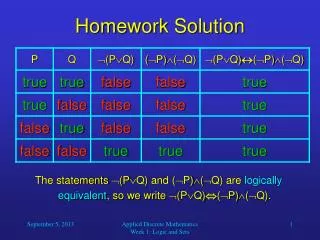
Homework Solution • The statements (PQ) and (P)(Q) are logically equivalent, so we write (PQ)(P)(Q). Applied Discrete Mathematics Week 1: Logic and Sets
… and now for something completely different… • Set Theory Actually, you will see that logic and set theory are very closely related. Applied Discrete Mathematics Week 1: Logic and Sets
Set Theory • Set: Collection of objects (“elements”) • aA “a is an element of A” “a is a member of A” • aA “a is not an element of A” • A = {a1, a2, …, an} “A contains…” • Order of elements is meaningless • It does not matter how often the same element is listed. Applied Discrete Mathematics Week 1: Logic and Sets
Set Equality • Sets A and B are equal if and only if they contain exactly the same elements. • Examples: • A = {9, 2, 7, -3}, B = {7, 9, -3, 2} : A = B • A = {dog, cat, horse}, B = {cat, horse, squirrel, dog} : A B • A = {dog, cat, horse}, B = {cat, horse, dog, dog} : A = B Applied Discrete Mathematics Week 1: Logic and Sets
Examples for Sets • “Standard” Sets: • Natural numbers N = {0, 1, 2, 3, …} • Integers Z = {…, -2, -1, 0, 1, 2, …} • Positive Integers Z+ = {1, 2, 3, 4, …} • Real Numbers R = {47.3, -12, , …} • Rational Numbers Q = {1.5, 2.6, -3.8, 15, …}(correct definition will follow) Applied Discrete Mathematics Week 1: Logic and Sets
Examples for Sets • A = “empty set/null set” • A = {z} Note: zA, but z {z} • A = {{b, c}, {c, x, d}} • A = {{x, y}} Note: {x, y} A, but {x, y} {{x, y}} • A = {x | P(x)}“set of all x such that P(x)” • A = {x | xN x > 7} = {8, 9, 10, …}“set builder notation” Applied Discrete Mathematics Week 1: Logic and Sets
Examples for Sets • We are now able to define the set of rational numbers Q: • Q = {a/b | aZ bZ+} • or • Q = {a/b | aZ bZ b0} • And how about the set of real numbers R? • R = {r | r is a real number}That is the best we can do. Applied Discrete Mathematics Week 1: Logic and Sets
Subsets • A B “A is a subset of B” • A B if and only if every element of A is also an element of B. • We can completely formalize this: • A B x (xA xB) • Examples: A = {3, 9}, B = {5, 9, 1, 3}, A B ? true A = {3, 3, 3, 9}, B = {5, 9, 1, 3}, A B ? true A = {1, 2, 3}, B = {2, 3, 4}, A B ? false Applied Discrete Mathematics Week 1: Logic and Sets
U B C A Subsets • Useful rules: • A = B (A B) (B A) • (A B) (B C) A C (see Venn Diagram) Applied Discrete Mathematics Week 1: Logic and Sets
Subsets • Useful rules: • A for any set A • A A for any set A • Proper subsets: • A B “A is a proper subset of B” • A B x (xA xB) x (xB xA) • or • A B x (xA xB) x (xB xA) Applied Discrete Mathematics Week 1: Logic and Sets
Cardinality of Sets • If a set S contains n distinct elements, nN,we call S a finite set with cardinality n. • Examples: • A = {Mercedes, BMW, Porsche}, |A| = 3 B = {1, {2, 3}, {4, 5}, 6} |B| = 4 C = |C| = 0 D = { xN | x 7000 } |D| = 7001 E = { xN | x 7000 } E is infinite! Applied Discrete Mathematics Week 1: Logic and Sets
The Power Set • 2Aor P(A) “power set of A” • 2A = {B | B A} (contains all subsets of A) • Examples: • A = {x, y, z} • 2A = {, {x}, {y}, {z}, {x, y}, {x, z}, {y, z}, {x, y, z}} • A = • 2A = {} • Note: |A| = 0, |2A| = 1 Applied Discrete Mathematics Week 1: Logic and Sets
The Power Set • Cardinality of power sets: • | 2A | = 2|A| • Imagine each element in A has an “on/off” switch • Each possible switch configuration in A corresponds to one element in 2A • For 3 elements in A, there are 222 = 8 elements in 2A Applied Discrete Mathematics Week 1: Logic and Sets
Cartesian Product • The ordered n-tuple (a1, a2, a3, …, an) is an ordered collection of objects. • Two ordered n-tuples (a1, a2, a3, …, an) and (b1, b2, b3, …, bn) are equal if and only if they contain exactly the same elements in the same order, i.e. ai = bi for 1 i n. • The Cartesian product of two sets is defined as: • AB = {(a, b) | aA bB} • Example: A = {x, y}, B = {a, b, c}AB = {(x, a), (x, b), (x, c), (y, a), (y, b), (y, c)} Applied Discrete Mathematics Week 1: Logic and Sets
Cartesian Product • Note that: • A = • A = • For non-empty sets A and B: AB AB BA • |AB| = |A||B| • The Cartesian product of two or more sets is defined as: • A1A2…An = {(a1, a2, …, an) | aiAi for 1 i n} Applied Discrete Mathematics Week 1: Logic and Sets
Set Operations • Union: AB = {x | xA xB} • Example: A = {a, b}, B = {b, c, d} • AB = {a, b, c, d} • Intersection: AB = {x | xA xB} • Example: A = {a, b}, B = {b, c, d} • AB = {b} Applied Discrete Mathematics Week 1: Logic and Sets
Set Operations • Two sets are called disjoint if their intersection is empty, that is, they share no elements: • AB = • The difference between two sets A and B contains exactly those elements of A that are not in B: • A-B = {x | xA xB}Example: A = {a, b}, B = {b, c, d}, A-B = {a} Applied Discrete Mathematics Week 1: Logic and Sets
Set Operations • The complement of a set A contains exactly those elements under consideration that are not in A: • -A = U-A • Example: U = N, B = {250, 251, 252, …} • -B = {0, 1, 2, …, 248, 249} • Table 1 in Section 2.2 (4th edition: Section 1.5; 5th edition: Section 1.7; 6th edition: Section 2.2) shows many useful equations for set identities. Applied Discrete Mathematics Week 1: Logic and Sets
Set Operations • How can we prove A(BC) = (AB)(AC)? • Method I: • xA(BC) • xA x(BC) • xA (xB xC) • (xA xB) (xA xC)(distributive law for logical expressions) • x(AB) x(AC) • x(AB)(AC) Applied Discrete Mathematics Week 1: Logic and Sets
Set Operations • Method II: Membership table • 1 means “x is an element of this set”0 means “x is not an element of this set” Applied Discrete Mathematics Week 1: Logic and Sets
Set Operations • Take-home message: • Every logical expression can be transformed into an equivalent expression in set theory and vice versa. Applied Discrete Mathematics Week 1: Logic and Sets
Exercises • Question 1: • Given a set A = {x, y, z} and a set B = {1, 2, 3, 4}, what is the value of | 2A 2B | ? • Question 2: • Is it true for all sets A and B that (AB)(BA) = ?Or do A and B have to meet certain conditions? • Question 3: • For any two sets A and B, if A – B = and B – A = , can we conclude that A = B? Why or why not? Applied Discrete Mathematics Week 1: Logic and Sets