Advancements in DIS Data and Partonic Structure: Insights from H1 Collaboration at ICHEP'02
This presentation details the latest findings from the H1 Collaboration, focusing on inclusive Deep Inelastic Scattering (DIS) data and its implications for partonic structure and Quantum Chromodynamics (QCD). Key results include new measurements of cross sections from e+p and e-p collisions at varying energies and Q², reflecting significant insights into parton distribution functions and their role in future particle physics experiments. The analysis includes comparative evaluations, scaling violations, and the measurement of structure functions like F₂ and xF₃, providing essential constraints on theoretical models.

Advancements in DIS Data and Partonic Structure: Insights from H1 Collaboration at ICHEP'02
E N D
Presentation Transcript
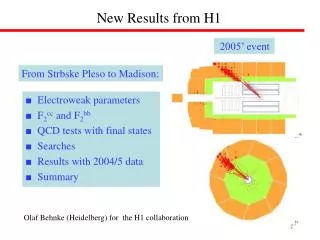
Structure Function Results From H1 Z. Zhang LAL, Orsay On behalf of the H1 Collaboration ICHEP'02, July 24-31, Amsterdam
Inclusive DIS Data n Partonic Structure & QCD Main published H1 Data: 1) e+p (94-97, ~36pb-1, @ 300 GeV) & 2) e-p (98-99, ~16pb-1, @ 320 GeV) : g High Q2 Neutral Current (NC)+ Charged Current (CC) cross sections 3) e+p (96-97, ~20pb-1, @ 300 GeV) g Precision low Q2 data • Major input to global fits • (MRST, CTEQ, …) • Universal Parton Density Functions (PDF) • Reliable predictions for - precision measurements & - search for new physics @ future hadron machines (LHC) • Questions: • What’s new? • What are the impacts of the HERA I data? • Can full HERA I cross sections (structure functions) data be described by QCD (DGLAP evolution equations)? ICHEP'02, July 24-31, Amsterdam
New Cross Section (s) Measurements e+p 99-00 (65pb-1, @ 320GeV): gsNC & sCC g 1st FL @ high Q2 Dedicated Runs ’99 (3pb-1): g FL @ low x Shifted Vertex ’00 (0.6pb-1) g insight into DIS/gp Radiative Events ’97 g extended phase space ICHEP'02, July 24-31, Amsterdam
Cross Sections and Structure Functions NC Cross Section: NC Reduced cross section: Dominant contribution Sizeable only at high y (y>~0.6) Contribution only important at high Q2 CC Cross Section: CC Reduced cross section: ICHEP'02, July 24-31, Amsterdam
New Reduced Cross Section (sr) at low Q2,small x • Extended phase space: • CM: 300g320GeV • Backward silicon tracker • Eeming3GeV or • zgznominal+70cm • sr changes behavior • at high y (small x) for • Q2>~2 GeV2 • g FL • Data with Q2g 0: • Valuable for studying • underlying dynamics • of DISggp ICHEP'02, July 24-31, Amsterdam
Determination of FL New FL extends the published one to lower x & higher Q2 Compare Experimental determination of FL with Theoretical expectation (QCD Fit): Scaling violation of F2 g xg g FL Good agreement thus provides a non-trivial consistency test New ICHEP'02, July 24-31, Amsterdam
Rise of F2 Towards Low x Measured dlnF2(x,Q2)/dlnx=-l(x,Q2) consistent with constant for x<0.01 g F2a x-l for fixed Q2 Deviation observed at Q2~1GeV2 in l(Q2) with respect to linear behavior in ln(Q2) when the new H1 data is combined with other data (H1, ZEUS, NMC) Hint on a change of strong interaction dynamics at low x for Q2~1GeV2 ? Regge prediction: 0.08 @ Q2~0 g ICHEP'02, July 24-31, Amsterdam Q2 /GeV2
NC Reduced Cross Sections (srNC) at High Q2 & Large x H1 Preliminary Compare new cross sections @ 320GeV with the published ones @ 300GeV Previously observed “excess” at Q2>10 000GeV2, x~0.4 not confirmed by new data The measured scaling variation well described by H1 QCD Fit (see below) ICHEP'02, July 24-31, Amsterdam
NC vs. CC & e+p vs. e-p NC e+p vs. e-p: s(e+p)=s(e-p) at low Q2 ng exchange s(e+p)<s(e-p) at high Q2 n Z contribution (gZ interf.) CC e+p vs. e-p: s(e+p)<s(e-p) n different partons different helicity factors s(e+p)~(u+c)+(1-y)2(dbar+sbar) s(e-p)~(ubar+cbar)+(1-y)2(d+s) g constraints on u & d type quarks NC vs. CC: sNC=sCC at high Q2 n Electroweak unification Good agreement between H1, ZEUS, and Global Fit (CTEQ) ICHEP'02, July 24-31, Amsterdam
Parity Violating Structure Function xF3 1st xF3 at High Q2: When precisely measured, xF3 will provide important constraint on u,d valence quark densities @ large x ICHEP'02, July 24-31, Amsterdam
CC Reduced Cross Sections: e+p vs. e-p The e+p cross sections differ from the e-p cross sections CC e+p (e-p) cross sections are unique for constraining d (u) quark density ICHEP'02, July 24-31, Amsterdam
NLO QCD Analyses & Impact of HERA I Data Several Fits with different emphases: Common features:DGLAP Evolution Equations,NLO, MSbar, Q20=4GeV2, Q2min=3.5GeV2 Syst. error correlation & relative normalization unc. properly considered 2) Fits for FL determination H1 data only at low y (<0.35) 3)General PDF fits Use all H1 data of HERA I (e+p, e-p, NC, CC, high & low Q2) with/without BCDMS mp & mD (ym>0.3) Up-, down-type quark & gluon densities simultaneously determined 1) Gluon density xg(x) @ small x & as: Eur. Phys. J. C21 (2001) 33, hep-ex/0012053 H1 data only (Q2<3000GeV2): d(xg(x))~3%(exp) @ Q2=20GeV2, x=3.10-4-0.1 H1 data + BCDMS(mp) (ym>0.3): as(M2Z)=0.1150 +- 0.0017 (exp) + 0.0009-0.0005 (model) +- 0.005 (th) Needs NNLO to improve scale(th) uncertainty ICHEP'02, July 24-31, Amsterdam
Quarks & Gluon Densities from H1 2002 PDF Fit • xq(x)=AqxBq(1-x)Cq[1+Dqx0.5+Eqx+Fqx2] • xU=x(u+c) • xD=x(d+s): FU=0 • xUbar: DUbar=0, FUbar=0 • xDbar: DDbar=0, EDbar=0, FDbar=0 • xg: Fg=0 • H1+BCDMS Fit: • c2=917/(1014-13)=0.92 • Exp. precision:dq(x)~a few % • Model uncertainty includes: • Variations of Q20, Q2min, as, • heavy quark mass threshold & • momentum fraction • H1 only Fit: • c2=548/(621-11)=0.90 It is the 1st time, PDFs can be constrained with HERA data only! 0 H1 Preliminary ICHEP'02, July 24-31, Amsterdam
u & d Quark Densities From H1 2002 PDF Fit: Best optimum precision of PDF without local fluctuation From Local Extraction Method: xq=smeas (xq/s)th Free from nuclear corrections Two methods are complementary HERA data start to constrain the u, d quark densities at large x ICHEP'02, July 24-31, Amsterdam
Summary and Outlook • With the increased proton beam energy (820g920GeV), • the new detector: backward silicon tracker • the improved ability to trigger lower energy electrons • Special dedicated runs • The HERA kinematical phase space has been substantially extended • The inclusive DIS data at HERA are confronted with NLO QCD analyses • QCD (the DGLAP equations) are able to describe • all the cross section data:e+p, e-p, NC, CC • all the structure functions: F2, FL, xF3 • in a huge kinematical range: both Q2 & x covering 5 orders of magnitude • Perspective @ HERA II: • Luminosity per experiment: 1fb-1 by 2006 • longitudinally polarized e+ or e- • QCD will be tested in DIS to a higher level of accuracy @ NNLO • New possibilities for precision measurements of electroweak parameters ICHEP'02, July 24-31, Amsterdam