Regents Physics
In this agenda, we will review Chapter 6, focusing on the concept of equilibrium and the equilibrant. An object is in equilibrium when the net force acting on it is zero, meaning no acceleration occurs. We will explore how to determine if forces result in equilibrium using vector addition. Additionally, we will practice finding the equilibrant, which counteracts resultant forces and produces equilibrium in a system. Practice problems will cover real-world applications such as tension in ropes supporting an object. Homework assignments will reinforce these concepts.

Regents Physics
E N D
Presentation Transcript
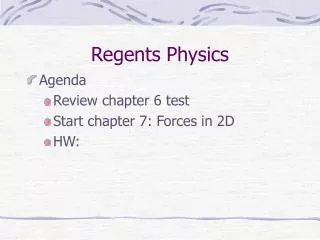
Regents Physics • Agenda • Review chapter 6 test • Start chapter 7: Forces in 2D • HW:
Equilibrium and the Equilibrant • An object is in equilibrium when the net force on it is zero • Zero net forces do not cause accelerations • In terms of vectors, equilibrium occurs when the resultant of three or more forces equals a net force of zero
Equilibrium • We use basic vector addition to determine if the resultant makes a closed triangle..thus a zero net force resulting in equilibrium
Finding the Equilibrant • Suppose two forces act on a system and the resultant is not zero…how could you find a third force, that when added to the other two, would add to zero? • Such a force, one that produces equilibrium, is called the equilibrant
Finding the Equilibrant • To find the equilibrant, move the move the forces and draw the resultant • The equilibrant is equal in magnitude to the resultant but opposite in direction B A Equilibrant
Practice Problem • A 168 N sign is supported in a motionless position by two ropes that each make 22.5 angles with the horizontal. What is the tension in the ropes? FA FB + x Fg Fnety = 0, so.. FAy + FBy – Fg = 0 FAsin + FBsin - Fg = 0 2FA sin = Fg FA = Fg = 168 N = 220 N 2sin 22.5 Fnet = 0, so.. –FAx + FBx = 0 -FAcos + FBcos = 0 FA = FB
Homework • Pg. 151-152 #1,2 • Pg. 171 #30,31 • SHOW ALL WORK