Download

1 / 25
250 likes | 405 Views
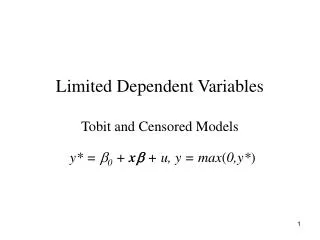
This document delves into statistical models used for analyzing limited dependent variables, focusing on censoring, Tobit, and hurdle models. It explains the fundamental concepts of censoring, corner solution models, and the Tobit model (y* = x'β + ε; y = max(0, y*)) with an emphasis on estimating relationships in conditions of censoring and corner solutions. A practical application using Fair's extramarital affairs data is provided, highlighting the nuances of partial effects and conditional mean functions, alongside the estimation challenges faced in regression analysis.

E N D
Censoring and Corner Solution Models • Censoring model: y = T(y*) = 0 if y* < 0 y = T(y*) = y* if y* > 0. • Corner solution: y = 0 if some exogenous condition is met; y = g(x)+e if the condition is not met. We then model P(y=0) and E[y|x,y>0]. • Hurdle Model: y = 0 with P(y=0|z) Model E[y|x,y > 0]
The Tobit Model y* = x’+ε, y = Max(0,y*), ε ~ N[0,2] Variation: Nonzero lower limit Upper limit Both tails censored Easy to accommodate. (Already done in major software.) Log likelihood and Estimation. See Appendix. (Tobin: “Estimation of Relationships for Limited Dependent Variables,” Econometrica, 1958. Tobin’s probit?)
Predictions and Residuals • What variable do we want to predict? • y*? Probably not – not relevant • y? Randomly drawn observation from the population • y | y>0? Maybe. Depends on the desired function • What is the residual? • y – prediction? Probably not. What do you do with the zeros? • Anything - x? Probably not. x is not the mean. • What are the partial effects? Which conditional mean?
Application: Fair’s Data Fair’s (1977) Extramarital Affairs Data, 601 observations. Psychology Today. Source: Fair (1977) and http://fairmodel.econ.yale.edu/rayfair/pdf/1978ADAT.ZIP. Several variables not used are denoted X1, ..., X5. y = Number of affairs in the past year, (0,1,2,3,4-10=7, more=12, mean = 1.46. (Frequencies 451, 34, 17, 19, 42, 38) z1 = Sex, 0=female; mean=.476 z2 = Age, mean=32.5 z3 = Number of years married, mean=8.18 z4 = Children, 0=no; mean=.715 z5 = Religiousness, 1=anti, …,5=very. Mean=3.12 z6 = Education, years, 9, 12, 16, 17, 18, 20; mean=16.2 z7 = Occupation, Hollingshead scale, 1,…,7; mean=4.19 z8 = Self rating of marriage. 1=very unhappy; 5=very happy Fair, R., “A Theory of Extramarital Affairs,” Journal of Political Economy, 1978. Fair, R., “A Note on Estimation of the Tobit Model,” Econometrica, 1977.
Fair’s Study • Corner solution model • Discovered the EM method in the Econometrica paper • Used the tobit instead of the Poisson (or some other) count model • Did not account for the censoring at the high end of the data
Two Part Hurdle Model Critical chi squared [7] = 14.1. The tobit model is rejected.
Panel Data Application • Pooling: Standard results, incuding “cluster” estimator(s) for asymptotic covariance matrices • Random effects • Butler and Moffitt – same as for probit • Mundlak/Wooldridge extension – group means • Extension to random parameters and latent class models • Fixed effects: Some surprises (Greene, Econometric Reviews, 2005)
Fixed Effects MLE for Tobit No bias in slopes. Large bias in estimator of