Understanding Imperialism: Concepts and Definitions
This piece explores the concept of imperialism, defined as the extension of a nation's authority over foreign countries and the acquisition of colonies. Issues surrounding raw materials, nationalism, indigenous populations, spheres of influence, and Social Darwinism are addressed. Nationalism emphasizes loyalty to one's nation, while the term "indigenous" refers to native characteristics of specific regions. Spheres of influence denote areas where one nation exerts control over others. Finally, Social Darwinism explains how social hierarchies may arise from natural selection.


Understanding Imperialism: Concepts and Definitions
E N D
Presentation Transcript
Imperialism By: Eryk Taylor
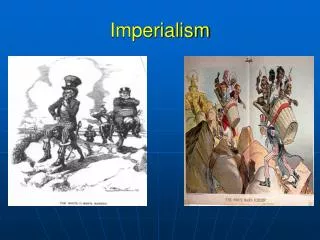
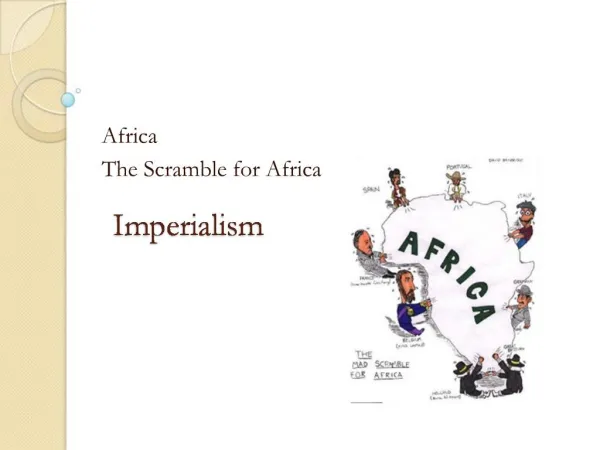
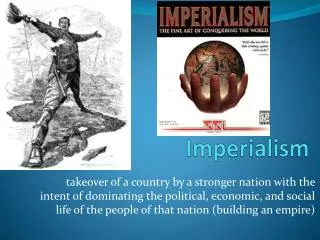
Imperialism • the policy of extending the rule or authority of an empire or nation over foreign countries, or of acquiring and holding colonies and dependencies.
Raw Materials • materialbeforebeingprocessedormanufacturedintoafinalform.
Nationalism • devotion and loyalty to one's own nation; patriotism.
Indigenous • originating in and characteristic of a particular region or country; native (often followed by to): the plants indigenous to Canada; the indigenous peoples of southern Africa.
Spheres of Influence • any area in which one nation wields dominant power over another or others.
Social Darwinism • a 19th-century theory, inspired by Darwinism, by which the social order is accounted as the product of natural selection of those persons best suited to existing living conditions and in accord with which a position of laissez-faire is advocated.