Overview of Protein Synthesis: From DNA to Active Proteins
200 likes | 320 Views
Protein synthesis is a fundamental biological process where DNA unwinds and mRNA is created using one of its strands as a template. The mRNA exits the nucleus to the cytoplasm, where it binds to the ribosome. tRNA molecules are 'charged' with amino acids that correspond to the mRNA codons. Translation involves the sequential binding of tRNAs to mRNA, facilitating the formation of peptide bonds and elongation of the polypeptide chain until a stop codon is reached, resulting in the creation of a new protein. This process is essential for cellular function and structure.


Overview of Protein Synthesis: From DNA to Active Proteins
E N D
Presentation Transcript
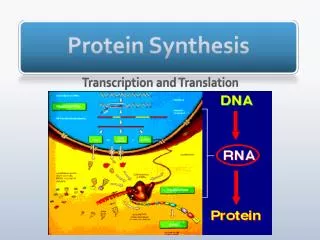
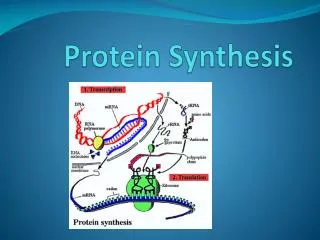
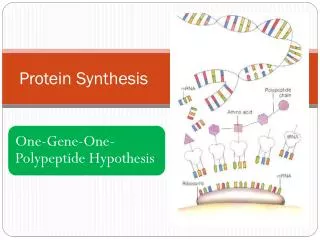
Protein synthesis • DNA unwinds • mRNA copy is made of one of the DNA strands (template strand). • mRNA copy moves out of nucleus via nuclear pore into cytoplasm. • tRNA molecules are activated or “charged” as their complementary amino acids are attached to their 3’ Acceptor site.
Aminoacyl-tRNA = tRNA with corresponding a.a. attached to its 3’ acceptor site
The mRNA attaches to the small subunit of the ribosome in cytoplasm with the help of the 5’ cap on the mRNA and protein initiation factors. A tRNA bonds complementarily with the start codon of the mRNA (AUG) via its anticodon (UAC) at the “P” site of the ribosome. A second tRNA bonds with the next three bases of the mRNA (at the “A” site).
The 2nd amino acid joins onto the amino acid of the first tRNA via a peptide bond catalyzed by peptidyl transferase, which is associated with the ribosome. The ribosome moves along. The first tRNA leaves the ribosome. A third tRNA brings a third amino acid Eventually a stop codon (UGA, UAG, UAA) is reached on the mRNA. The newly synthesised polypeptide leaves the ribosome with the help of a protein “Release Factor.”
1. • First the mRNA attaches itself to a ribosome (to the small subunit). • Six bases of the mRNA are exposed. • A complementary tRNA molecule with its attached amino acid (methionine) base pairs via its anticodon UAC with the AUG on the mRNA in the first position P. • Another tRNA base pairs with the other three mRNA bases in the ribosome at position A. • The enzyme peptidyltransferase (associated with the ribosome) forms a peptide bond between the two amino acids. • The first tRNA (without its amino acid) leaves the ribosome.
Translation 2 The ribosome moves along the mRNA to the next codon (three bases). The second tRNA molecule moves into position P. Another tRNA molecule pairs with the mRNA in position A bringing its amino acid. A growing polypeptide is formed in this way until a stop codon is reached.
End of Translation A stop codon (UGA, UAG, UAA) on the mRNA is reached and this signals the ribosome to leave the mRNA. A newly synthesised protein is now complete!
Wobble Hypothesis – a tRNA can recognize more than one codon where the 3rd nucleotide differs