Download
1 / 1
10 likes | 138 Views
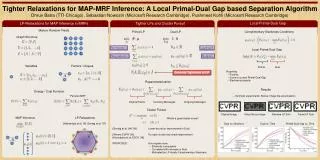
This work presents a novel approach to improve MAP inference in Markov Random Fields (MRFs) through local primal-dual gap-based LP relaxations. We introduce tighter linear programming formulations and investigate their properties, including complementary slackness conditions. Our algorithm efficiently handles graph structures and enhances margin calculations, particularly for pairwise MRFs. We validate our approach through synthetic experiments, showcasing improvements in cluster scoring and energy functions while achieving superior MAP estimates in applications like stereo and image deconvolution.

E N D
Tighter Relaxations for MAP-MRF Inference: A Local Primal-Dual Gap based Separation Algorithm Dhruv Batra (TTI-Chicago), Sebastian Nowozin (Microsoft Research Cambridge), Pushmeet Kohli (Microsoft Research Cambridge) Local Primal-Dual Gap LP-Relaxations for MAP Inference in MRFs Tighter LPs and Cluster Pursuit Markov Random Fields Primal LP Dual LP Complimentary Slackness Conditions Graph Structure Normalization Lagrangian Local Primal-Dual Gap Marginalization Multipliers Variables Factors / Cliques Primal Dual Properties -- Positive -- Sums to current Primal-Dual Gap -- Slackness property Controls Tightness of LP Reparameterization Results Energy / Cost Function Pairwise MRF -- Synthetic experiments; Stereo; Image De-convolulation Original Factor Incoming Messages Outgoing Messages Cluster Pursuit Original Image Noisy Blurry Image Pairwise LP Soln Triplet LP Soln MAP Inference LP Relaxations What’s a good cluster score? [Wainwright et al. ‘08, Sontag et al. ‘07] Dual vs. Iterations Dual vs. Time Primal-Dual Gap vs. Time [Sontag et al. UAI ’08] Lower-bound on improvement in Dual [Werner CVPR ’08] Try each cluster and check improvement [Komodakis et al. ECCV ‘08] PROPOSED: A surrogate score -- Efficiently computable -- Correlated with increase in Dual -- Motivated by LP duality Complimentary Slackness