Exploring Media Interactivity: The Nature of Interaction in Digital Communications
In this lecture by Professor Victoria Meng, we delve into the evolving nature of media interactivity. We discuss key concepts from renowned thinkers such as Alan Turing, David Rokeby, and Ken Hillis to examine the implications of interactivity in digital media. What defines interactivity, and how do authors articulate its impact on user experience? Are we moving towards a more immersive digital environment, and how do machines challenge our understanding of thought and consciousness? Join us as we unpack these critical themes in remote communications.

Exploring Media Interactivity: The Nature of Interaction in Digital Communications
E N D
Presentation Transcript
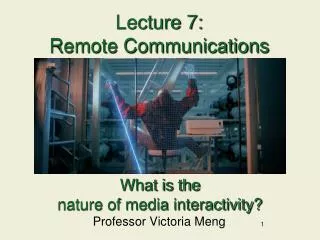
Lecture 7:Remote Communications Professor Victoria Meng What is the nature of media interactivity?
Learning Tasks • Alan Turing, “Computing Machinery and Intelligence.” • David Rokeby, “Transforming Mirrors: Subjectivity and Control in Interactive Media.” • Ken Hillis, “A Critical History of Virtual Reality.” • Tron, Animotion, Neave Games
Lev Manovich: Automation • “Low-level:” performs specific tasks. • “High-level:” aka “artificial intelligence.” • “Media access:” search and retrieval from databases.
Alan Turing • British mathematician, cryptographer (1912-1954) • Pioneered computer science with the “Turing machine” • Tragic death
Alan Turing Diagram of a Turing Machine, which can be adapted into a “Universal Machine.”
Post-War Context Atomic bomb Enigma Machine
Can Machines Think? Boris Karloff as Frankenstein’s Monster
How Can We Know If Machines Think? • How do we ascertain that people think? • We “just know.” • Brain imaging technology. • IQ tests and other tests that evaluate performance. • How can we find the right test(s) to measure “machine thought?”
How Can We Know If Machines Think? • Some “skill” operations are not comparable (computer: PWN!). Left: Gary Kasparov Right: Deep Blue Match date: May 11, 1997
How Can We Know If Machines Think? • We equate “thinking” with “consciousness” – processes and sensations that are not yet quantifiable.
How Can We Know If Machines Think? • We equate “thinking” with “consciousness” – processes and sensations that are not yet quantifiable. • The stakes are high: thinking makes us “special.”
The Turing Test “The Thinker,” Auguste Rodin, 1902
The Turing Test A provocative and influential way to “measure” artificial intelligence.
The Turing Test Makes users bear the “burden of proof” – it’s true if you believe it. Sets human-computer transcoding as the programming problem.
The Turing Test Tangent: What are the strengths and limitations of tests, papers, and other assessment tools? How well do they predict behavior?
The Turing Test Makes users bear the “burden of proof” – it’s true if you believe it. Sets human-computer transcoding as the programming problem. Posits that “humanity” is a performance and can be “decoded.”
The Turing Test Memory v. Memory?
The Turing Test “Hello, Hal: will we ever get a computer we can really talk to?” John Seabrook, The New Yorker, June 23 2008
Media Interactivity “Hello, Hal: will we ever get a computer we can really talk to?” John Seabrook, The New Yorker, June 23 2008
The Turing Test Makes users bear the “burden of proof” – it’s true if you believe it. Sets human-computer transcoding as the programming problem. Posits that “humanity” is a performance. Underestimates complexities of human cognition.
Interactivity/Immersion Lecture Title: Remote Communications: What is the nature of media interactivity?
Interactivity/Immersion What do authors like Hillis and Rokeby assert about digital media? Do they agree?
Interactivity/Immersion What is interactivity?
Interactivity/Immersion What is interactivity? - mutual v. uni-directional effects?
Interactivity/Immersion What is interactivity? - mutual v. uni-directional effects? - communication v. command and/or control?
Interactivity/Immersion What is interactivity? - mutual v. uni-directional effects? - communication v. command and/or control? - What/Who is interacting with what/whom? How does this change the way we think about interactivity?
Interactivity/Immersion Me Alexey Pajitnov
Interactivity/Immersion Me Alexey Pajitnov Paul Neave
Interactivity/Immersion Me Alexey Pajitnov Paul Neave Tetris
Interactivity/Immersion Me, again! Alexey Pajitnov Paul Neave Tetris
David Rokeby: “Transforming Mirrors” Left: The Life and Opinions of Tristram Shandy, Gentleman (Laurence Sterne, 1759-69) Right: “The Bride Stripped Bare by Her Bachelors, Even” (Marcel Duchamp, 1915-23)
David Rokeby: “Transforming Mirrors” “A technology is interactive to the degree that it reflects the consequences of our actions or decisions back to us.” (133)
David Rokeby: “Transforming Mirrors” • Read last paragraphs of 154, 155. • Navigable structure/space. • Medium specificity. • Transforming mirror. • Automaton.
Ken Hillis: “A Critical History of Virtual Reality” • Historical account – antidote for technological determinism. Link Trainer (hydraulic flight simulator, 1930s-50s)
Ken Hillis: “A Critical History of Virtual Reality” • Role of stories in history: why science fiction is important. Tron (Lisberger, 1982)
Ken Hillis: “A Critical History of Virtual Reality” Tron (Lisberger, 1982)
Ken Hillis: “A Critical History of Virtual Reality” • Minds, bodies, transcendence and connection… Animotion, Manuel Fallmann, 2004. Tip: Don’t change the library before you’re done – you’ll lose all your work.
End of Lecture 7 Next Lecture: Everything is Exchangeable: How do the whole and its parts relate in digital media?