Understanding Human Joints: Types, Function, and Injury Prevention
Explore the significance of human joints in movement and stability, essential for an active lifestyle. Each year, millions face sports-related injuries, with basketball and biking leading the statistics. Learn about different joint types including synovial, cartilaginous, and fibrous, and their roles in enabling motion. Understand how ligaments and fibrocartilage contribute to joint stability. This guide will also emphasize injury prevention strategies, ensuring you can enjoy your favorite activities safely. Knowledge is power—stay informed!

Understanding Human Joints: Types, Function, and Injury Prevention
E N D
Presentation Transcript
~ HUMANJOINTS~ PSE 4U: Exercise Science Westdale Secondary School
No PAIN! No GAIN! • Emergency Rooms across North America tallied more than 4 million sportsand recreation-related injuries last year. See how your favourite pastime rates to the E.R.-o-meter: • Basketball 213,847 • Bicycling 147,140 • Lifting/Running 88,532 • Football 61,353 • Softball 50,824 • Fishing 17,798 • Golf 8,469 OUCH!
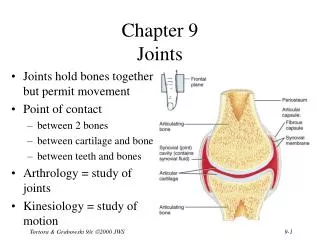
Introduction to the Articular System • Bones are too rigid to bend without being damaged. Fortunately, flexible connective tissues form joints that hold bones together while still permitting some degree of movement, in most cases. • Most movements of the body occur at joints, you can appreciate their importance if you imagine how a cast over the knee joint makes walking difficult or how a splint on a finger limits the ability to manipulate small objects. The scientific study of joints is referred to arthrology. The study of motion of the human body is called kinesiology.
Joint Classification • A joint consists of cartilage and fibrous connective tissue. • A joint in the human body is defined as the point at which two or more bones join together. • An articulation (joint) is a point of contact between bones, between cartilage and bones, or between teeth and bones. When we say one bone articulates with another bone, we mean that one bone forms a joint with another bone.
Synovial Joint • Freely movable (DIARTHRODIAL) • Space between the articular surface of the bones forming the joint • A synovial membrane surrounds the joints and secretes a lubricating fluid called synovial fluid • Example – Shoulder, Knee, Hip • Classified by the number of axis about which they rotate (e.g., uniaxial, biaxial)
Cartilaginous Joint • Stable joint • Also called AMPHIARTHRODIAL • Somewhat moveable • Example – Intervertebral discs • Can be divided into two groups: • Syndesmosis – held together by strong ligaments which allow for minimal movements between the bones • Synchondrosis – joint separated by a fibrocartilage that allows for slight movement between the bones (Example of the joints betweenthe Ribs and Sternum)
Fibrous or Sutured Joint • Very stable • Also called SYNARTHRODIAL • No movement • Example – Sutures in the Skull
JOINT TYPES • There are a number of joints found within the human body: • HINGE JOINT • GLIDING JOINT • BALL and SOCKET JOINT • PIVOT JOINT • SADDLE JOINT • IMMOVABLE JOINT
HINGE JOINT • Bones that fit together like two part of a hinge – convex surface of one bone fits into the concave surface of another bone • Examples include ankle, elbow, phalanges • 1 axis..Usually flexion, extension, and hyperextension
GLIDING JOINT • The gliding surfaces are flat and the surfaces merely slide across one another • Limited movement; only side to side and back and forth movements are permitted • 0 axis; twisting and rotating are usually prohibited by attached ligaments or adjacent bones • Example include the carpals
BALL & SOCKET JOINT • The ball shape of one bone fits into the socket shape of the other (movement is multi- axial) • 3 axes; they allow three types of movements including flexion/extension, abduction/adduction, and rotation / circumduction • Examples include the shoulder and hip
PIVOT JOINT • One bone rotates around another, movement is only in one axis • Movement is permitted in only one plane, usually rotation • Examples include atlas/axis
SADDLE JOINT • Freely moving joint that resembles a saddle in two axes (oval head into shallow cavity); the articular surface of one bone is saddle-shaped and the articular surface of another bone is shaped like a rider sitting in the saddle • This joint is biaxial; movements are side to side, back and forth and sometimes circumduction • Ball and socket movement without rotation • Example include the 1st metacarpal and carpal at base of the thumb
IMMOVABLE JOINT • Bones that join but do not move • No axes • Examples include the cranium and teeth sutures
JOINT CHARACTERISTICS • A joint is the articulation of two or more connecting bones. The joint either provides stability or mobility. • Uniaxial - Move about one axis i.e.. Hinge • Biaxial - Movement about two axes i.e.. Ellipsoid • Triaxial - Movement about three exes i.e.. Ball & Socket • Nonaxial - Sliding motion rather than rotating i.e.. Wrist/Hand
RELATED JOINT STRUCTURES • LIGAMENTS • Strong connective tissues that run from bone to bone and help to maintain stability in a joint • Ligaments are not elastic and can lose their ability to perform correctly when stretched • They are NOT highly elastic and lost their ability to perform correctly when stretched • Prevents dislocation of bones – if they are repeatedly stretched or torn, survey may be necessary
RELATED JOINT STRUCTURES • Fibrocartilage • Occupies the space between certain bones to form the articular surface and can take on many sizes and shapes • Fibrocartilage is round and are known as disks (e.g., those between the vertebrae of the spine) while others may be flat or circular in shape (e.g., knee) • Resilient and functions as the shock absorber • It has no blood supply of its own and relies on synovial fluid for nourishment
RELATED JOINT STRUCTURES • Synovial Membrane • A synovial membrane is a thin tissue that surrounds most freely moving joints • The membrane secretes synovial fluid which provides nourishment for cartilaginous disks, lubrication, and hydrostatic cushioning
RELATED JOINT STRUCTURES • Bursae • Bursae is a liquid filled membrane that protects soft tissues as they pass by bony projections
RELATED JOINT STRUCTURES • Joint Capsule • A joint capsule is a tough fibrous sheet that surrounds many joints and functions to protect them and to provide stability • Surrounds the bony ends to form a joint cavity • Secretes synovial fluid to lubricate the area inside the joint capsule
RELATED JOINT STRUCTURES • Hyaline Cartilage • Covers bone ends to grease joint surface for smooth, friction-free movement • Most abundant in the human body