Download
1 / 44
440 likes | 560 Views
Explore the clever methods of applying Kirchhoff's laws to find voltages and currents in resistive circuits. Learn how to define currents, utilize node and loop laws to simplify variables, and derive necessary equations for solving complex circuits. The content also covers the combination of capacitors in both series and parallel connections, highlighting the differences in voltage and charge across these configurations. With step-by-step examples of charging and discharging behaviors in RC circuits, you'll gain a deeper understanding of critical electrical concepts.

E N D
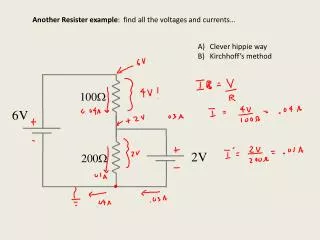
Another Resister example: find all the voltages and currents… Clever hippie way Kirchhoff’s method
Another Resister example: find all the voltages and currents… Clever hippie way
Another Resister example: find all the voltages and currents… b) Now try Kirchhoff's method The procedure …
Another Resister example: find all the voltages and currents… 1.) Define currents
Another Resister example: find all the voltages and currents… 2.) use node law to reduce variables
Another Resister example: find all the voltages and currents… 3.) use loop laws to get equations Solve em ….
Another Resister example: find all the voltages and currents… 4.) Solve em.
Equivalent Capacitors: Parallel connection
Parallel capacitors Same voltage!
Equivalent Capacitors: Series connection.
Equivalent Capacitance ? External charge stored
Series capacitors Same charge!
NOTE: The Rules for combining series and parallel capacitors are BACKWARDS from The Rules for combining series and parallel resistors !
Series EXAMPLE Next page room
t = 0, switch just closed CHARGING
t1: Now some time has passed CHARGING
t2: Now a lot of time has passed CHARGING
CHARGING Number example: What are the voltages across R and across C at a time t = 0.010 s after the switch is closed? Next page
DISCHARGING RC Circuits – time behavior!
DISCHARGING RC Circuits – time behavior!
DISCHARGING Number example: What are the voltages across R and across C at a time t = 0.010 s after the switch is closed? Next page