Download
1 / 20
200 likes | 322 Views
This study utilizes Geographic Information Systems (GIS) to explore one-year retention patterns of community college transfer students at DePaul University, drawing from Tinto’s, Bean’s, and Adelman’s retention models. It addresses varying definitions of “transfer,” the absence of centralized data, and the impact of institutional and demographic characteristics. By analyzing data from 4,285 students between 1999-2003, it provides insights into retention based on geographic location, focusing on non-retained versus retained students. Findings also discuss implications for admissions, recruitment, and strategic planning.

E N D
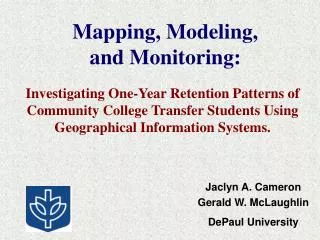
Mapping, Modeling, and Monitoring: Investigating One-Year Retention Patterns of Community College Transfer Students Using Geographical Information Systems. Jaclyn A. Cameron Gerald W. McLaughlin DePaul University
CC Research Caveats: • Varying definitions of “Transfer” • Lack of central data source • Differences in tracking techniques • Student goal motivations and aspirations
Transfer into 4-year institutions Degree-seeking First-time at reporting institution Only attended 2-yr institution Transferring in 30+ semester hours (45+ quarter hours) Top five feeder schools Retention/Grad rates Fall to fall tracking By Gender and Race % Part time Institutional Characteristics Transfer admit policies Transfer requirements Transfer credit policies CSRDE: Community College Transfer Report
CC Transfer Report Uses: • Benchmarking/Comparisons • Institution Characteristics • Carnegie Classification • Institution Size • Institution Selectivity • Institution State • Student Characteristics • % Part time • Race • Gender • Combinations of Institution and Student Characteristics
CC “Understudied” Research • Type of institution defined by geographical location (rural, urban, etc) • Demographic • Geographic • Economic • Institutional • Population Density • Metropolitan / Non-metropolitan • Importance of Culture and Community
CC Location Research Issues • Lack of universal definitions • Rural, Urban, Suburban • Student academic aspirations • College access • Community Characteristics • Educational value beliefs • Primary community employment • Cultural traditions
Geographic Information Systems Interpret and represent geographic data • Admissions, Recruitment, Marketing, Enrollment Offices • Support and direct Strategic Goals • Facilities / Space Management Offices • Facility locale or improvement • Alumni, Advancement • Identify “hotspots”
Selection Criteria CC Transfers Enrolled b/t Fall 1999 and Spring 2003 Degree Seeking 45+ Quarter Hours (30 Semester) First Year = 12 Hours Data Composition 4,285 Students Caucasian Female Full Time 89% Retained 11% Not Retained Method - Data
Method - Analyses • Density Maps • Total Sample and Non-Retained • Previous address zip code frequency • Community College location • Proportional Map • Non-retained / Retained • Zip Code density • Proportion for each zip code • Predicted Probability • Logistic regression error terms • Transfer hours, cumulative hours, cumulative GPA, full/part time • Proportion of Non-retained that were predicted to be retained
Community College Transfer Student Population by Previous Geographic Location: 1999-2003 DePaul
Non-Returning Community College Transfer Student Population by Previous Geographic Location: 1999-2003
Proportion of Non-Retained/Retained Students by Zip Code: 1999-2003
Predicted Probability to Retain of Non-Retained Transfer Students by Zip Code: 1999-2003
Conclusion • Old Issue – New Techniques • Future Research • Global to street level • U.S. Census data • Student Characteristics • Benchmarking and Trend Info
Thank You! Jaclyn Cameron jcamero4@depaul.edu Gerry McLaughlin gmclaugh@depaul.edu