Download
1 / 15
160 likes | 324 Views
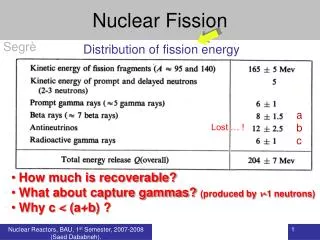
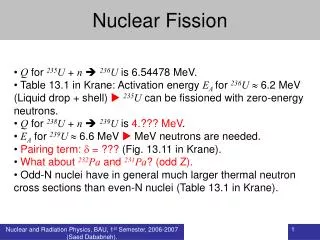
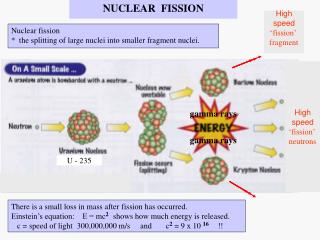
Nuclear fission involves the splitting of large atomic nuclei into smaller fragments. When Uranium-235 (U-235) undergoes fission, high-speed neutrons initiate subsequent fission events, leading to a chain reaction. This process results in a small loss of mass, as described by Einstein's equation E=mc², which translates to significant energy release. Each fission event can yield over 200 million electron volts of energy, making U-235 a critical fuel for nuclear reactors. This article explores the mechanisms of nuclear fission, including the roles of control rods, moderators, and efficiencies in power generation.

E N D
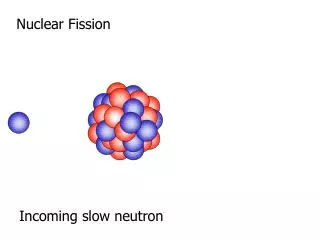
NUCLEAR FISSION gamma rays gamma rays High speed ‘fission’ fragment Nuclear fission * the splitting of large nuclei into smaller fragment nuclei. High speed ‘fission’ neutrons U - 235 There is a small loss in mass after fission has occurred. Einstein’s equation: E = mc2 shows how much energy is released. c = speed of light 300,000,000 m/s and c2 = 9 x 10 16 !!
gamma rays gamma rays gamma rays gamma rays Chain reaction * occurs when one fission event causes further fission events . In a nuclear bomb two pieces of pure U 235 or Pu 239 are forced together to exceed the critical mass of 4.5kg. Sub critical masses lose too many neutrons so the chain reaction does not take place U - 235 Fission neutrons cause further fission Fissionable isotopes: Only Uranium -235 is fissionable in the nuclear reactor. Plutonium -239 is also fissionable and is created from the more common Uranium 238. ( 99% of natural uranium is U 238.)
A PWR REACTOR Boron/steel control rods absorb surplus neutrons. Their depth allows one neutron per fission to produce one further fission Fuel rods with enriched U having 3% U 235 instead of less than 1% ( the rest is U 238) A moderator slows down the fast moving neutrons to allow successful collisions with U235 nuclei
a nucleus of U-235 or P-239 splits U-235 P-239 A C B A
If all the mass in a spoonful of sugar (5g) was converted to energy by Einstein’s equation: E = mc2 c = speed of light 300,000,000 m/s and c2 = 9 x 10 16 Q1. How much energy is released? Q2. If the UK needs 50GW of power and power stations are 30% efficient , how long could a spoonful of sugar keep the UK supplied with electricity? E = m x c2 E = 5 x 10 -3 x 9 x 10 16 E = 45 x 10 13 J
If all the mass in a spoonful of sugar (5g) was converted to energy by Einstein’s equation: E = mc2 c = speed of light 300,000,000 m/s and c2 = 9 x 10 16 Q1. How much energy is released? Q2. If the UK needs 50GW of power and power stations are 30% efficient , how long could a spoonful of sugar keep the UK supplied with electricity? E = m x c2 E = 5 x 10 -3 x 9 x 10 16 E = 45 x 10 13 J
If all the mass in a spoonful of sugar (5g) was converted to energy by Einstein’s equation: E = mc2 c = speed of light 300,000,000 m/s and c2 = 9 x 10 16 Q1. How much energy is released? Q2. If the UK needs 50GW of power and power stations are 30% efficient , how long could a spoonful of sugar keep the UK supplied with electricity? % Efficiency = useful power x 100% total power total power = 50 x 10 9 x 100% 30% = 167 x 10 9 W E = m x c2 E = 5 x 10 -3 x 9 x 10 16 E = 45 x 10 13 J
If all the mass in a spoonful of sugar (5g) was converted to energy by Einstein’s equation: E = mc2 c = speed of light 300,000,000 m/s and c2 = 9 x 10 16 Q1. How much energy is released? Q2. If the UK needs 50GW of power and power stations are 30% efficient , how long could a spoonful of sugar keep the UK supplied with electricity? % Efficiency = useful power x 100% total power total power = 50 x 10 9 x 100% 30% = 167 x 10 9 W E = m x c2 E = 5 x 10 -3 x 9 x 10 16 E = 45 x 10 13 J Power = Energy transferred time time (sec) = Energy transferred = 45 x 10 13 J = 0.27 x 10 4 sec Power 167 x 10 9 W = 45 Mins
If all the mass in a spoonful of sugar (5g) was converted to energy by Einstein’s equation: E = mc2 c = speed of light 300,000,000 m/s and c2 = 9 x 10 16 Q1. How much energy is released? Q2. If the UK needs 50GW of power and power stations are 30% efficient , how long could a spoonful of sugar keep the UK supplied with electricity? % Efficiency = useful power x 100% total power total power = 50 x 10 9 x 100% 30% = 167 x 10 9 W E = m x c2 E = 5 x 10 -3 x 9 x 10 16 E = 45 x 10 13 J
If all the mass in a spoonful of sugar (5g) was converted to energy by Einstein’s equation: E = mc2 c = speed of light 300,000,000 m/s and c2 = 9 x 10 16 Q1. How much energy is released? Q2. If the UK needs 50GW of power and power stations are 30% efficient , how long could a spoonful of sugar keep the UK supplied with electricity? % Efficiency = useful power x 100% total power total power = 50 x 10 9 x 100% 30% = 167 x 10 9 W E = m x c2 E = 5 x 10 -3 x 9 x 10 16 E = 45 x 10 13 J Power = Energy transferred time time (sec) = Energy transferred = 45 x 10 13 J = 0.27 x 10 4 sec Power 167 x 10 9 W = 45 Mins
If all the mass in a spoonful of sugar (5g) was converted to energy by Einstein’s equation: E = mc2 c = speed of light 300,000,000 m/s and c2 = 9 x 10 16 Q1. How much energy is released? Q2. If the UK needs 50GW of power and power stations are 30% efficient , how long could a spoonful of sugar keep the UK supplied with electricity? % Efficiency = useful power x 100% total power total power = 50 x 10 9 x 100% 30% = 167 x 10 9 W E = m x c2 E = 5 x 10 -3 x 9 x 10 16 E = 45 x 10 13 J Power = Energy transferred time time (sec) = Energy transferred = 45 x 10 13 J = 0.27 x 10 4 sec Power 167 x 10 9 W = 45 Mins
If all the mass in a spoonful of sugar (5g) was converted to energy by Einstein’s equation: E = mc2 c = speed of light 300,000,000 m/s and c2 = 9 x 10 16 Q1. How much energy is released? Q2. If the UK needs 50GW of power and power stations are 30% efficient , how long could a spoonful of sugar keep the UK supplied with electricity? % Efficiency = useful power x 100% total power total power = 50 x 10 9 x 100% 30% = 167 x 10 9 W E = m x c2 E = 5 x 10 -3 x 9 x 10 16 E = 45 x 10 13 J Power = Energy transferred time time (sec) = Energy transferred = 45 x 10 13 J = 0.27 x 10 4 sec Power 167 x 10 9 W = 45 Mins so 1Kg bag of sugar could keep the national grid running for 6 days!
Nuclear Bombs Sub critical masses
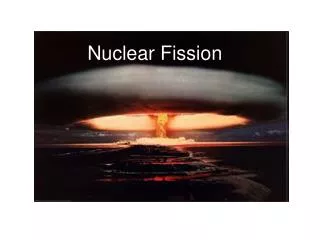
Nuclear Bombs above critical mass