Understanding Ethernet, Bridges, and Spanning Trees in LAN Architecture
This document explores critical concepts in Ethernet networking from a CS/ECE course at UIUC. It revisits Ethernet backoff mechanisms after collisions, introduces the capture effect, and discusses the functionalities of bridges in extending LANs. Key concepts such as collision handling, spanning tree algorithms, and the limitations of bridges are examined. The document also addresses the creation of robust network structures through controlled forwarding and loop management using spanning trees, ensuring efficient data transmission across interconnected LANs.

Understanding Ethernet, Bridges, and Spanning Trees in LAN Architecture
E N D
Presentation Transcript
Bridges and LAN Switches CS/ECE 438 - UIUC, Fall 2007
Ethernet Backoff revisited • After N collisions, pick a number k between 0 and 2N-1 • Wait for k*51.2 us • Send frame if no one has started using the channel CS/ECE 438 - UIUC, Fall 2007
Repeated Collisions • Suppose A, B, and C each have a frame to send, causing a collision • A picks k=0, B and C pick k=1 • A wins, sends frame • After A is done, B and C both try to send again • Collision again • Increase collision counter CS/ECE 438 - UIUC, Fall 2007
Capture Effect • A and B collide • A picks 0, B picks 1 • A wins, transmits frame • Suppose A has another frame to send • A and B collide again • A’s collision counter is 1, pick k from 0,1 • B’s collision counter is 2, pick k from 0,1,2,3 • A is likely to win again • And keep winning! CS/ECE 438 - UIUC, Fall 2007
Bridges: Building Extended LAN’s • Traditional LAN • Shared medium (e.g., Ethernet) • Cheap, easy to administer • Supports broadcast traffic • Problem • Scale LAN concept • Larger geographic area (> O(1 km)) • More hosts (> O(100)) • But retain LAN-like functionality • Solution • bridges CS/ECE 438 - UIUC, Fall 2007
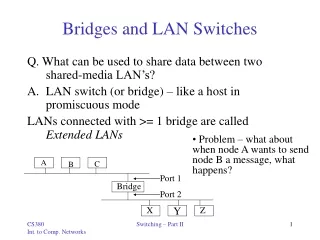
Bridges • Problem • LANs have physical limitations • Ethernet – 1500m • Solution • Connect two or more LANs with a bridge • Accept and forward • Level 2 connection (no extra packet header) • A collection of LANs connected by bridges is called an extended LAN CS/ECE 438 - UIUC, Fall 2007
Bridges vs. Switches • Switch • Receive frame on input port • Translate address to output port • Forward frame • Bridge • Connect shared media • All ports bidirectional • Repeat subset of traffic • Receive frame on one port • Send on all other ports CS/ECE 438 - UIUC, Fall 2007
Uses and Limitations of Bridges • Bridges • extend LAN concept • Limited scalability • to O(1,000) hosts • not to global networks • Not heterogeneous • some use of address, but • no translation between frame formats CS/ECE 438 - UIUC, Fall 2007
Bridges with Loops • Problem • If there is a loop in the extended LAN, a packet could circulate forever • Side question: Are loops good or bad? • Solution • Select which bridges should actively forward • Create a spanning tree to eliminate unnecessary edges • Adds robustness • Complicates learning/forwarding CS/ECE 438 - UIUC, Fall 2007
Example Extended LAN with LOOPS A B B9 B7 B5 C F D K B2 B1 J E G H B B4 I CS/ECE 438 - UIUC, Fall 2007
Spanning Tree Algorithm • View extended LAN as bipartite graph • LAN’s are graph nodes • Bridges are also graph nodes • Ports are edges connecting LAN’s to bridges • Spanning tree required • Connect all LAN’s • Can leave out bridges CS/ECE 438 - UIUC, Fall 2007
Defining a Spanning Tree • Basic Rules • Bridge with the lowest ID is the root • For a given bridge • A port in the direction of the root bridge is the root port • For a given LAN • The bridge closest to the root (or the bridge with the lowest ID to break ties) is the designated bridge for a LAN • The corresponding port is the designated port • Bridges with no designated ports and ports that are neither a root port nor a designated port are not part of the tree. CS/ECE 438 - UIUC, Fall 2007
D D D R R D D D R D D D R R D D Spanning Tree Algorithm A B Root B9 B7 B5 D – designated port C F D K B2 B1 B1 R – root port J E G H B B4 I CS/ECE 438 - UIUC, Fall 2007
A B B7 B5 C F D K B2 B1 B1 J E G H B4 I Using a Spanning Tree: Forwarding • Forwarding • Each bridge forwards frames over each LAN for which it is the designated bridge or connected by a root port CS/ECE 438 - UIUC, Fall 2007
Finding the Tree by a distributed Algorithm • Bridges run a distributed spanning tree algorithm • Select when bridges should actively forward frames • Developed by Radia Perlman at DEC • Now IEEE 802.1 specification CS/ECE 438 - UIUC, Fall 2007
Distributed Spanning Tree Algorithm • Bridges exchange configuration messages • (Y,d,X) • Y = root node • d = distance to root node • X = originating node • Each bridge records current best configuration message for each port • Initially, each bridge believes it is the root • When a bridge discovers it is not the root, stop generating messages CS/ECE 438 - UIUC, Fall 2007
Distributed Spanning Tree Algorithm • Bridges forward configuration messages • Outward from root bridge • i.e., on all designated ports • Bridge assumes • It is designated bridge for a LAN • Until it learns otherwise • Steady State • root periodically send configuration messages • A timeout is used to restart the algorithm CS/ECE 438 - UIUC, Fall 2007
Spanning Tree Algorithm (5,1,1) A B (5,0,5) (9,0,9) B9 (7,0,7) B7 B5 (9,1,2) (7,1,1) (9,2,1) C F D (2,0,2) K B2 (2,1,1) B1 J (1,0,1) E G H (6,0,6) (4,0,4) B6 B4 (4,1,1) (6,1,1) I CS/ECE 438 - UIUC, Fall 2007
Bridges: Limitations • Does not scale • Spanning tree algorithm scales linearly • Broadcast does not scale • Virtual LANs (VLAN) • An extended LAN that is partitioned into several networks • Each network appears separate • Limits effect of broadcast • Simple to change virtual topology CS/ECE 438 - UIUC, Fall 2007
Bridges: Limitations • Does not accommodate heterogeneity • Networks must have the same address format • e.g. Ethernet-to-Ethernet • Caution • Beware of transparency • May break assumptions of the point-to-point protocols • Frames may get dropped • Variable latency • Reordering • Bridges happen! CS/ECE 438 - UIUC, Fall 2007
Switch • Link layer device • stores and forwards Ethernet frames • examines frame header and selectively forwards frame based on MAC dest address • when frame is to be forwarded on segment, uses CSMA/CD to access segment • transparent • hosts are unaware of presence of switches • plug-and-play, self-learning • switches do not need to be configured CS/ECE 438 - UIUC, Fall 2007
switch hub hub hub Forwarding 1 2 3 • How do determine onto which LAN segment to forward frame? • Looks like a routing problem... CS/ECE 438 - UIUC, Fall 2007
Self learning • A switch has a switch table • entry in switch table: • (MAC Address, Interface, Time Stamp) • stale entries in table dropped (TTL can be 60 min) • switch learns which hosts can be reached through which interfaces • when frame received, switch “learns” location of sender: incoming LAN segment • records sender/location pair in switch table CS/ECE 438 - UIUC, Fall 2007
Filtering/Forwarding • When switch receives a frame: index switch table using MAC dest address if entry found for destination then { if dest on segment from which frame arrived then drop the frame else forward the frame on interface indicated } else flood forward on all but the interface on which the frame arrived CS/ECE 438 - UIUC, Fall 2007
Switch example address interface Suppose C sends frame to D switch 1 1 1 2 3 A B E G 3 2 hub hub hub A I F D G B C H E • Switch receives frame from from C • notes in bridge table that C is on interface 1 • because D is not in table, switch forwards frame into interfaces 2 and 3 • frame received by D CS/ECE 438 - UIUC, Fall 2007
Switch example interface address Suppose D replies back with frame to C. switch 1 1 2 3 1 A B E G C hub hub hub A I F D G B C H E • Switch receives frame from from D • notes in bridge table that D is on interface 2 • because C is in table, switch forwards frame only to interface 1 • frame received by C CS/ECE 438 - UIUC, Fall 2007
switch hub hub hub Switch: traffic isolation • switch installation breaks subnet into LAN segments • switch filters packets: • same-LAN-segment frames not usually forwarded onto other LAN segments • segments become separate collision domains collision domain CS/ECE 438 - UIUC, Fall 2007 collision domain collision domain
Switches: dedicated access A • Switch with many interfaces • Hosts have direct connection to switch • No collisions; full duplex Switching: A-to-A’ and B-to-B’ simultaneously, no collisions C’ B switch C B’ A’ CS/ECE 438 - UIUC, Fall 2007
More on Switches • cut-through switching: frame forwarded from input to output port without first collecting entire frame • slight reduction in latency • combinations of shared/dedicated, 10/100/1000 Mbps interfaces CS/ECE 438 - UIUC, Fall 2007
Institutional network mail server to external network web server router switch IP subnet hub hub hub CS/ECE 438 - UIUC, Fall 2007
Switches vs. Routers • both store-and-forward devices • routers: network layer devices (examine network layer headers) • switches are link layer devices • routers maintain routing tables, implement routing algorithms • switches maintain switch tables, implement filtering, learning algorithms CS/ECE 438 - UIUC, Fall 2007
Summary comparison CS/ECE 438 - UIUC, Fall 2007