Understanding Natural Selection and Interactions in Ecosystems
Chapter 1 explores the concept of natural selection, first proposed by Charles Darwin in 1859, which explains how living organisms adapt to their environments over time. It discusses the importance of evolutionary adaptations for species survival and recounts the historic debate between Thomas Huxley and Bishop Wilberforce. The chapter delves into the niche of organisms within their habitats and outlines three main types of ecological interactions: competition, predation, and symbiosis. These interactions are crucial for understanding the complexities of ecosystems.

Understanding Natural Selection and Interactions in Ecosystems
E N D
Presentation Transcript
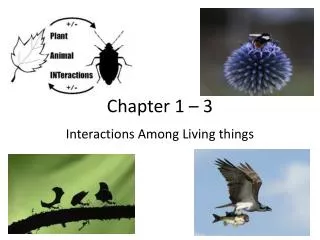
Chapter 1 – 3 Interactions Among Living things
Natural Selection is that process by which, over time, living things become better suited to their environments. This was first suggested by Charles Darwn in 1859
Darwin suggested that through reproduction, natural selection encourages organisms to change and adapt to their environments. Successful evolutionary adaptations ensure the survival of a species.
In a famous 1860 court debate with Bishop Samuel Wilberforce, English Biologist Thomas H. Huxley defended evolution:
His opponents enjoyed it when Bishop “Soapy Sam” Wilberforce asked him, “Are you descended from an ape, Mr. Huxley, from your mother’s or your father’s side?” Huxley’s reply put Wilberforce’s “science” into perspective. If such a question were to be put to me, Huxley replied, “would I rather have a miserable ape for a grandfather or a man highly endowed by nature and possessed of great influence and yet who employs these faculties and that influence for the mere purpose of introducing ridicule into a grave scientific discussion, I unhesitatingly affirm my preference for the ape.”
The role of an organism in its habitat is called its niche. That is, all the actions including feeding, reproduction, living patterns and locations are considered parts of an organism’s niche.
Three types of interactions occur among organisms. *Competition*Predation*Symbosis
Competition is the struggle between organisms to survive as they attempt to use the same limited resources.
Predation is interaction in which one organism kills another for food.
Predator/Prey Adaptations include:Speed, Eyesight Camouflage False Coloring
Symbiosis is a relationship between two species that benefits at least one. Three types of Symbiosis include:
Mutualism – Both Species Benefit!Yellow-billed Oxpecker & HippoStinging Ants and Acacia Tree
Commensalism – One species benefits and other is unharmed. Not common in nature.Red-Tailed Hawk & Saguaro Cactus
Parasitism – Parasite benefits and host is harmed.Fleas, Ticks, Leeches, Worms, Mites, Chiggers