Download
1 / 23
230 likes | 330 Views
This presentation outlines the research goal, methods, results and future work of studying pharmaceuticals in surface water to ensure drinking water safety. The study focused on detecting acidic pharmaceuticals like Ibuprofen in Huron River samples. Utilizing GC-MS analysis technique, the study identified Ibuprofen, highlighted the need for derivatization techniques, and suggested future research directions for trace analysis enhancement.

E N D
Study of Pharmaceuticals in the surface water by GC-MS Badrinath Dhakal Beatrice Benhamida December-8, 2009
Presentation Outline • Introduction • Research Goal • Preparation of samples and derivatization • Instrumentation and Experimental Procedure • Result and discussion • Conclusion • Future Work
Introduction • ~ 3,000 different compounds used in medicines • ~80% or more of the drugs pass through the body unaltered1 • 95 Organic wastewater contaminants (OWCs) in USA2 • Abnormal physiological processes, reproductive impairment, increased incidence of cancer, development of antibiotic-resistant bacteria, potential toxicity of chemical mixture,…
Why is it necessary to analyze pharmaceuticals in water?? • To find the actual information(research value) • To ensure safety of drinking water • Emergency response • To raise awareness and be prepared for the consequences
Methods available • LC-MS: Low sensitivity • HPLC-MS-MS: High sensitivity but expensive and difficult to develop method (EPA method): 74 pharmaceuticals detected till 2007. • GC-MS-MS: High sensitivity but difficult to develop & expensive • GC-MS: Easy to develop, comparatively high sensitivity & cheap.
Research Goal • To identify the acidic pharmaceuticals in the surface water : Acetylsalicylic acid, Ibuprofen and Naproxen • To quantify these pharmaceuticals present in the surface water • To develop a suitable method for the qualitative as well as quantitative analysis of these pharmaceuticals in water
Preparation of samples and standards • Sample water was collected from the Huron River • Filtration of the samples: GlassmicroFiber filter 691 VWR brand • Solid phase extraction: AccuBond SPE ODS-C18 cartridge, Agilent Technologies • Derivatization of the samples : • N,O-bis (trimethylsilyl) trifluoroacetamide (BSTFA)3 • Phenyltrimethylammonium hydroxide(5% in methanol), TCI America
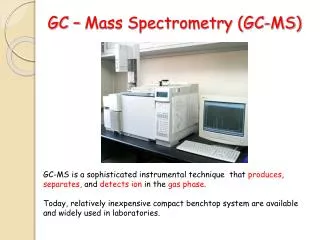
Instrumentation and GC-MS Analysis • Gas chromatography with Mass spectrometer as detector • Varian Chrompack CP-3800 • Varian Saturn 2000 GC/MS • Column 30m long: 5% PDMS, 0.25µm film thickness, 0.25 mm internal diameter • Less-polar stationary phase (strongly-bonded)
Instrumentation &….. • 2 µL sample injected, derivatization at the injection port • EI Auto Scan mode, Range: 40-650, • flow rate: 1.3 ml/min, • Column Oven temp: 70 0c, 10 0 per min up to 250 0 holding for 5 min. • Total time: 25 min. • Stabilization time : 0.25 min
Chromatograms of the standards ibu nap asa
Chromatograms of conc. Std. solution & spiked samples Ibu Nap. ASA
Chromatograms of Std. solution and Huron river water sample Ibu nap
Conclusion • Only Ibuprofen was detected in the sample water • ASA was not detected in the concentration as high as 100 ppm by this method • Ibuprofen and Naproxen detectable up to 1 ppm. • Use of Internal standard is necessary for the quantitative analysis of these compounds • Appropriate derivatization technique is needed for the trace analysis of these compounds
Future Work • Additional derivatizing agents for these compounds can be explored for the enhancement of trace analysis • New methods of sample preparation, extraction and derivatization can be helpful for the simultaneous analysis of these compounds
References • 1. Togola A.; Budzinski H. , Anal. Bioanal. Chem. (2007) 388:624 • 2. U.S. Geological Survey(1999-2000), Environmental Science and Technology / VOL.36, NO.6,2002 • 3. Budzinski H.; Togola A; Devier MH;Labadie P. Anal. Bioanal. Chem. (2007) 388:624
Acknowledgement • Dr. R.A. Armitage