Download
1 / 9
100 likes | 212 Views
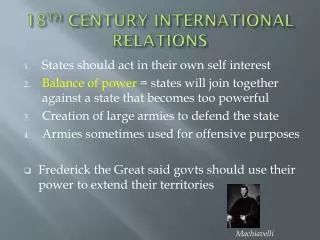
18 TH CENTURY INTERNATIONAL RELATIONS. States should act in their own self interest Balance of power = states will join together against a state that becomes too powerful Creation of large armies to defend the state Armies sometimes used for offensive purposes

E N D
18TH CENTURY INTERNATIONAL RELATIONS • States should act in their own self interest • Balance of power = states will join together against a state that becomes too powerful • Creation of large armies to defend the state • Armies sometimes used for offensive purposes • Frederick the Great said govts should use their power to extend their territories Machiavelli
“reason of state” • Rulers began to see their primary task as insuring the health and strength of the state and not seeing the state as their own personal possession
THE STORY OF 18TH CENTURY WAR AND DIPLOMACY • International rivalry • Continuing centralization of state power • Creation and support of large standing armies and navies • Need for more taxes • Need for more efficient and effective bureaucrats = employees of the state
THE TWO GREAT CONFLICTS OF THE 18TH CENTURY • The War of the Austrian Succession • The Seven Years’ War
THE WAR OF THE AUSTRIAN SUCCESSION 1740-1748 • No male heir to Habsburg throne • The Pragmatic Sanction = other rulers agree to recognize the emperor’s daughter as legal heir • Empress Maria Theresa comes to the throne in 1740 • Prussian king Frederick the Great takes advantage of the new empress by invading Austrian Silesia • Other countries join either Austria or Prussia • Treaty of Aix-la-Chapelle = all sides exhausted -> Prussia keeps Silesia -> nothing really settled • Prussia and Austria remain bitter enemies Frederick the Great takes advantage of Maria Theresa -> seizes Silesia
“THE DIPLOMATIC REVOLUTION” • After the loss of Silesia -> Maria Theresa rebuilds her army • Austria engineers “the diplomatic revolution” = Austria and France switch from being rivals to being allies • Russia joins with Austria and France • Britain allies with Prussia • The new alliances open the way for The Seven Years’ War Maria Theresa
THE SEVEN YEARS’ WAR 1756-1763 • Three major areas of conflict – • Europe • India • North America • Prussia + Britain v. Austria + France + Russia • Frederick the Great is almost overwhelmed and almost conquered • Russia drops out of the war • Prussia is able to hang on and survive the war • Austria agrees to allow Prussia to keep Silesia
THE SEVEN YEARS’ WAR OVERSEAS -> THE FIRST GLOBAL WAR • The great war for empire • British led by Robert Clive drive the French out of India • The French and Indian War = British v. French in N. America • William Pitt – British PM -> organizes victory in N. America • British naval power gives them advantage • British General Wolfe defeats French General Montcalme at Quebec • French lose control of and are driven out of N. America The death of General Montcalme The Seven Years’ War in N. America = the French and Indian
EUROPEAN ARMIES AND WARFARE • Increase in the size of armies • Aristocrats are the officers in the army • Soldiers came mostly from lower classes • Some countries relied on mercenaries and foreign soldiers • Armies and military equipment was expensive so rulers were careful not destroy them • In battle the strategy was to avoid direct conflict -> engage in maneuvers and strategy