Supergranulation Scale Convection Simulations: Insights into Solar Surface Dynamics
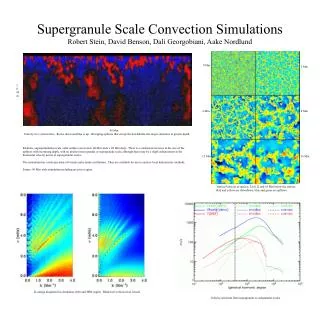
This study presents high-resolution simulations of solar surface convection, focusing on supergranulation scale dynamics. Spanning an area of 48 Mm by 20 Mm, the simulations reveal divergent upflows that integrate downdrafts into larger structures at increased depths. Notably, the increasing size of upflows with depth is observed, yet distinct meso-granule or supergranule scales are not identified. A rich spectrum of f-mode and p-mode oscillations is produced, allowing for further analysis via local helioseismic methods. Future simulations of 96 Mm and active regions are planned.

Supergranulation Scale Convection Simulations: Insights into Solar Surface Dynamics
E N D
Presentation Transcript
Supergranule Scale Convection SimulationsRobert Stein, David Benson, Dali Georgobiani, Aake Nordlund 0 Mm 2 Mm 20 Mm 4 Mm 8 Mm 48 Mm Velocity in a vertical slice. Red is down and blue is up. Diverging upflows that sweep the downdrafts into larger structures at greater depth. Realistic, supergranulation scale, solar surface convection: 48 Mm wide x 20 Mm deep. There is a continuous increase in the size of the upflows with increasing depth, with no distinct meso-granule or supergranule scale, although there may be a slight enhancement in the horizontal velocity power at supergranular scales. The simulation has a rich spectrum of f-mode and p-mode oscillations. They are available for use to analyze local helioseismic methods. Future: 96 Mm wide simulation including an active region. 16 Mm 12 Mm Vertical Velocity at surface, 2,4,8,12 and 16 Mm below the surface. Red and yellow are downflows, blue and green are upflows. K-omega diagrams for simulation (left) and MDI (right). Black line is theoretical f-mode. Velocity spectrum from supergranule to subgranular scales