Download
1 / 18
180 likes | 286 Views
This document outlines a direct physics-based implementation of the Finite-Difference Time-Domain (FDTD) method for simulating electromagnetic (EM) wave propagation in materials resembling human tissues. The simulation employs relative dielectric constants and conductivity to accurately model biological tissues. Key components of the code specify parameters within computational cells, and the FDTD loop processes field updates based on interactions between the electromagnetic fields. Results demonstrate an EM pulse propagating towards a material akin to human fat or bone, illustrating the simulation's effectiveness.

E N D
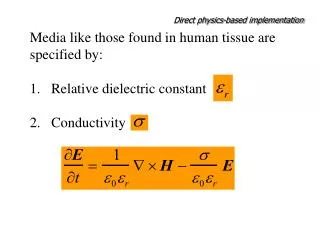
Direct physics-based implementation Media like those found in human tissue are specified by: 1. Relative dielectric constant 2. Conductivity
Direct physics-based implementation ( These are included in the FDTD formulation: Note that the last term is written as the average over two cells
Direct physics-based implementation This leads to the following C computer code: Specify the parameters in the cells: eaf = dt*sigma/(2*epsz*epsilon) ca[k] = (1. - eaf)/(1. + eaf) cb[k] =0.5/(epsilon*(1. + eaf)). Computer code in the main loop: ex[k] = ca[k]*ex[k] + cb[k] *( hy[k-1] - hy[k] ) hy[k] = hy[k] + 0.5*( ex[k] - ex[k+1] )
Direct physics-based implementation The following simulation shows an EM pulse propagating in free space and then striking a material with e = 5, s = 0.05. (Approximately the values for human fat or bone.)
The cells between 100 and 200 have been assigned the properties