Analyzing Recent Canadian Immigration Cases: Family Class, Bad Faith, and Legal Interpretations
80 likes | 196 Views
This analysis delves into significant Canadian immigration cases, exploring key interpretations of the Immigration and Refugee Protection Act (IRPA). The text discusses the standards for genuine relationships, the implications of bad faith claims, and the evolving definition of family under the law. It reviews the cases of Lu v. Canada, Macapagal v. Canada, Vong v. Canada, and De Guzman v. Canada, highlighting aspects such as residency intentions, cultural contexts, and legislative purposes. Ultimately, it raises essential questions about evidentiary standards and tribunal decision consequences within immigration law.


Analyzing Recent Canadian Immigration Cases: Family Class, Bad Faith, and Legal Interpretations
E N D
Presentation Transcript
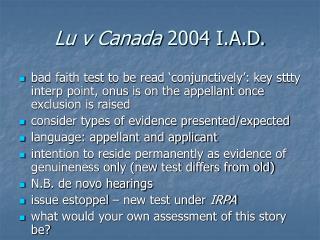
Lu v Canada 2004 I.A.D. • bad faith test to be read ‘conjunctively’: key sttty interp point, onus is on the appellant once exclusion is raised • consider types of evidence presented/expected • language: appellant and applicant • intention to reside permanently as evidence of genuineness only (new test differs from old) • N.B. de novo hearings • issue estoppel – new test under IRPA • what would your own assessment of this story be?
Macapagal v Canada 2004 I.A.D. • test for conjugal relationship: interdependence and 7 indicative factors • after this estd move on to bad faith analysis (? likely to fail here?) • N.B. use of Phillipine law • consequences of tribunal level decision • how does the evidence here compare with Lu? As counsel, what evidence would you submit?
Vong v Canada 2004 I.A.D. • ‘mother’ is undefined in the IRPA and IRPR • nuturing relationship, recogzd in the community + possibly other factors, more than one mother is possible • looks to old Act and draws conclusion on the basis of a lack of definition • evidence of how Vietnamese society views stepmothers • intent of Parliament to anticipate shifting attitudes toward family (??) • note comments re H&C considerations
Natt v Canada 2004 FC • adoption validity and adding members to the family class • they were her dependent children at all times • culture context of understanding of adoption • what legislative purpose [seems to] animate s 117(9)(d)? • compare facts and legal argument to Guzman
Nguyen v Canada 2003 FCTD • remember trial division no longer exists • modern purposive approach to statutory interpretation: look to the object and purpose of the legislation, n.b. use of objectives clause • what do you think of the statement that “…such an interpretation is consistent with the principle of family reunification…” (at para 17)? • what does para 19 mean?
De Guzman v Canada FCA 2005 • challenge to the s.117(9)(d) family class bar firmly rejected, SCC has denied leave • 3 arguments: • regulation is ultra vires • s. 7 of the Charter is breached • international human rights law is infringed
misrepresentation and suspicion of ‘being a bad mother’ • IRPA as framework legislation • Charter: restriction of fundamental choices & psychological stress • s. 25 of IRPA used at several points here • s. 3(3)(f) grounds international law argument • ‘hybrid response to international law argument: ‘signatory’, open set, mandatory language • held: interpretive guidance • no infringement here (CRC, ICCPR), both instruments are in fact ratified
Wrap Up Points – Family Class • spouse or common law partner in Canada class (begins reg 123) for legal temporary residents (not conjugal partners) • family related inadmissibility (Act s 42, Regs s 23) • reg 1 has a general defn of ‘family member’, and reg 2 defines ‘relative’ • s. 28 (Act) residency requirement