Understanding Forced Oscillations, Damping, and Resonance in Physics
This overview focuses on the concepts of forced oscillations, damping, and resonance within the context of physics. Damping occurs due to resistive forces such as friction, leading to energy dissipation and preventing systems from exhibiting simple harmonic motion (SHM). Various degrees of damping are discussed: underdamped, critically damped, and overdamped. The definition of resonance is explored, highlighting its occurrence when the frequency of forced vibrations matches an object’s natural frequency, illustrated by real-world examples like the Tacoma Narrows Bridge.

Understanding Forced Oscillations, Damping, and Resonance in Physics
E N D
Presentation Transcript
Oscillations and Waves Forced Oscillations and Resonance
Damping • - Caused by resistive forces that always oppose motione.g. friction • Energy is dissipatedby these forces. E.g. friction or magnetic damping can result in kinetic energy being dissipated as heat energy flows from the system. • Damped systems do not describe SHM.
under critical over • Degrees of damping • under damped: this means the body will oscillate before coming to rest at the equilibrium position. • critically damped: the body will come to rest at the equilibrium position in the shortest possible time, without oscillating. • - over damped: this means the body will take longer to come to rest
Resonance • Natural frequency:the frequency at which a body will freely oscillate at if plucked or banged or otherwise set in motion. • Forced oscillations: these occur when a ‘driver’ oscillating bodycauses another body (the ‘driven’ body) to oscillate at the same frequency (not necessarily its natural frequency). • Resonance:This occurs when the forced vibration frequency of the driver is equal to a driven objects natural frequency.
Physics Resonance of a text book
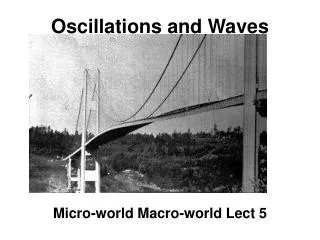
E.g. The Tacoma narrows suspension bridge • Video clip • E.g.Breaking a wine glass using resonance • You tube clip
Subtitle Text
Subtitle Text
Subtitle Text
Subtitle Text
Subtitle Text
Subtitle Text