What do dolphins understand about hidden objects?
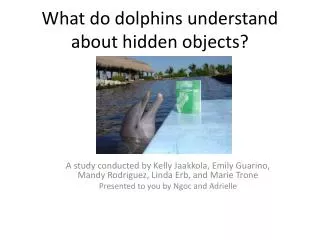
What do dolphins understand about hidden objects?. A study conducted by Kelly Jaakkola, Emily Guarino, Mandy Rodriguez, Linda Erb, and Marie Trone Presented to you by Ngoc and Adrielle. Introduction. Ability to track objects associated with spatial cognition

What do dolphins understand about hidden objects?
E N D
Presentation Transcript
What do dolphins understand about hidden objects? A study conducted by Kelly Jaakkola, Emily Guarino, Mandy Rodriguez, Linda Erb, and Marie Trone Presented to you by Ngoc and Adrielle
Introduction • Ability to track objects associated with spatial cognition • Object permanence “ability to mentally represent and reason about objects that have disappeared from view”
Introduction • Piaget-six stages of object permanence. • Stage 6 = ability to track movements of hidden objects • Marks emergence of new representational capacity. • Perner-invisible displacement task one of several abilities that show capacity for secondary representation.
Introduction • Apes able to pass invisible displacement tasks. • Monkeys-controversial. • Some studies don’t control for association rules. • Dogs and cats unable to pass. • use association rules instead of true understanding. • Birds also controversial. • Method of training may result in learning association rules.
Introduction • Cetaceans and primates both show higher cognitive abilities--like secondary representation. • Dolphins have ability to imitate, mirror self recognition, means-end reasoning, ability to understand symbols.
Can dolphins reason about the movements of hidden objects? Introduction
Experiment 1—Set Up • Aleta, Delphi, Pandora, Pax, Rainbow, and Tanner • Four males, two females • ages 3-27 years old • All did regular training and public interactions • 3 trash cans • 3 Rubbermaid lids, connected with PVC bar • 1 stuffed toy alligator • 1 opaque PVC cylinder
Displacement conditions • Single visible displacement—put object in one bucket only • Double visible displacement—put object in one bucket, then move to a second • Invisible displacement—put object in cylinder, cylinder in bucket, and remove cylinder without object
Testing • 1 week per condition • 2 sessions per condition, over 2 consecutive days • 6 choice trials and 3 errorless trials per session • Trial order randomized • Refresher session day before test
Training • Object is visible from bucket • One bucket, object is entirely hidden • Introduce object and signal • Intro buckets, then lids • Errorless trials
Procedure • Hider calls dolphin • Hide object • Put lid on • Hider gets the Asker • Ask question verbally and with hand signal • Dolphin chooses (with rostrum, or snout) • Removes lid • Correct--pulls object out, blows whistle, reward • Incorrect--asker shows empty bucket and finds correct bucket to show to the dolphin
Disruptions Trial aborted if: Redo: Reset if another dolphin comes over If another behavior response or no response, then signal is given again • Dolphin swims away • Touched bucket before signal • Touched something else • If 3 aborted trials in a row, trial is skipped and coded incorrect
Coding • Choice is indicated by dolphin touching rostrum (snout) to the bucket, lid, or the displacement cylinder • Video recordings used to • double check results • second experimenter to independently code (100%) reliability
Results and Accuracy • Motivation was high • *Rainbow’s data omitted from this trial—still significant results • Overall averages • Single displacement: above chance, P= 0.05 • Double displacement: no success, P= 0.158 • Invisible displacement: no success, P= 0.187
Order Effects and Strategies Order Effects Individual Strategies Correct responding First bucket in which object was placed Cylinder, or bucket closest to cylinder Favored bucket– 9 out of 12 selections For 1.-3., 8 out of 12 selections indicate use of a strategy • Single displacement first • typically did better • Perhaps large leap from testing to training?
Discussion • Overall average: • Single: pass • Double: fail • Invisible: fail Dolphins do not typically reach for things.
Experiment 2—Set Up • AJ, Calusa, Pax*, and Tanner* (Pax and Tanner from Exper. 1 • 1 female, 3 males • ages 4-18 years old • All did regular training and public interactions • Same trash cans and toy alligator • One large lid made from PVC pipe and canvas • Same cylinder
Differences Displacement conditions Testing 3 conditions over 3 days Invisible and Transposition counterbalanced Vanishing cylinder test within 5 days after Four trials for each bucket location 12 trials per session 2 sessions per day • Double visible • Invisible • Transposition • Vanishing cylinder—same as 2., but remove cylinder from testing area
Training • Pax and Tanner—refresher from Experiment 1 • New subjects given same basic training • Changes to training • No errorless trials • Objects hidden completely • Introduce different lid
Procedure Same as Experiment 1, except for: • Incorrect bucket—asker removed object from correct bucket; did not show empty bucket • If dolphin was distracted, trial was aborted, then “timeout,” and trial was put at the end of sessions • 3 skipped trials = end session
Results and Accuracy • Motivation was high • Second experimenter coded, 99% reliability • Overall averages • Double displacement: above chance, P= 0.004 • Invisible displacement: no success, P= 0.0464 • transposition: no success, P= 0.760 • No sig. main effect of previous experience, P=0.1888
Effects and Strategies Effect of cylinder presence Individual Strategies Same as Experiment 1 plus Selecting moved bucket Only one instance • Dolphins new to the study • Still a chance performance • Experienced dolphins • Much better without cylinder present
Discussion • Overall average: • Double: pass • Invisible: fail • Transposition: fail Surprising performance: no containers in natural environment
Experiment 3 • Same dolphins as Experiment 2. • Same buckets and lids. • Same procedure for trials. • Toy mouse (small enough to fit in hands).
Displacement Conditions • Hand displacement • Drop-first condition • Drop-last condition
Results • Dolphins performed above chance only for hand displacement (P < 0.001). • Not drop-first (P=0.215) or drop-last (P=0.058).
Discussion • More naturalistic • All dolphins able to complete to pass this invisible displacement condition. • They may be selecting the last bucket the experimenter pays attention to. • Unable to determine bucket with hidden object if experimenter pays attention to more than one bucket.
Experiment 4 • Same dolphins, same objects, same procedure. • Same displacement condition as in Experiments 1 & 2 but object is placed in 1st bucket that experimenter visits. • Control for possibility that dolphins are choosing last bucket that trainer touched.
Results • Dolphins performed above chance (P=0.011). • Compared to double visible displacement task from Experiment 2. • Visible drop-first and drop-last comparison • Not significant (P=0.89). • Success on visible displacement not due to using a simple response strategy.
Overall Results • Visible displacement: pass • Tracking hidden objects: fail • Invisible displacement task: ?? • With hands used instead of cylinder, performance was better
Discussion • In past research, “dolphins are proficient in tasks requiring symbolic or secondary representation.” • If Stage 6 object permanence=symbolic/secondary representation, why did the dolphins fail at these tasks?
Possible Reason 1--Experiment is not suited to display ability • Different from other permanence studies • Used explicitly trained responses • Perhaps dolphins did not understand task • Only difficulty was with hidden movement; they knew to seek object
Possible Reason 2—Perceptual disadvantage • No echolocation • Difficulty perceiving object details • No, because difficulty was when objects were not perceivable
Possible Reason 3—Dolphins do not have these abilities • Not likely • Shown evidence of secondary representation in other research
Secondary Representation--Support • Imitation • Mirror self-recognition: mark test • Means-ends reasoning • Attributing attention: follow trainers’ gaze • Understanding external representations • Televised images • Yes/no questions
Questions Raised Maybe… But… Maybe? Visible drop-first test Removing cylinder did not improve success • Higher memory load? • Distracting movements? • Inhibit preferred responses? Suggestion: test with visually and acoustically opaque occluders instead of containers
Summary • Success with visible displacement task, not invisible or transposition • Very puzzling, considering other success • Can do other tasks that are not part of natural behaviors • Perhaps a lack of understanding containers or experience with tracking an object hidden from sight and echolocation • Maybe echolocation helps track hidden objects