Download
1 / 9
90 likes | 208 Views
The New Kingdom of Egypt saw significant shifts, particularly during the reign of Amenhotep IV (Akhenaton). Ascending to power in 1370 B.C., he sought to curb the influence of powerful priests by introducing a monotheistic religion centered on worshipping Aton, the sun disc. His radical reforms led to the closure of temples and the displacement of traditional priesthood. Despite his devotion, Akhenaton's neglect of state affairs weakened Egypt, leading to territorial losses. His son-in-law, Tutankhamen, later restored the old religion but met an untimely end, marking the decline of the New Kingdom under Ramses II and beyond.

E N D
The New Kingdom continued
A Religious Reformer • Amenhotep IV (ah-muhn-hoh-tehp) came into power in 1370 B.C. • Amenhotep felt priests were gaining too much power • introduced a new religion with only one god in order to maintain his own power • Aton (the god) was to be worshipped • Priests who did not follow the new religion were removed from power, their lands were seized, closed temples • Changed name to Akhenaton (ahk-nah-tuhn) meaning “Spirit of Aton”
Queen Nefertiti Akhenaton Aton was described as being the creative force in the universe. It manifested itself as a solar disc with rays extending out, ending as hands.
Most Egyptians refused to accept the new religion • Akhenaton became so devoted to his new religion that he neglected his other duties • Administrators hired not as experienced as the priests • He took no action when the Hittites attacked Egypt lost most land in western Asia, shrinking empire
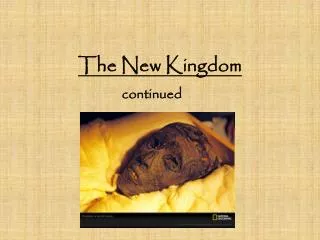
The Boy King • When he died, son-in-law inherited throne Tutankhamen(too-tang-kah-muhn) • 10years old • Help from palace officials and priests, who convinced him to restore old religion • Ruled for 9 years • Died unexpectedly- fell? murdered? • Now nicknamed “King Tut”
Tomb found by a British archaeologist named Howard Carter in 1922 • Incredible treasures, gold mask of the young pharaoh’s face • Important because most royal tombs were robbed long ago
The End of the New Kingdom • Ramses II reigned from 1279 B.C. to 1213 B.C. • One of the most effective pharaohs • Armies regained lands in western Asia and rebuilt the empire • “Ramses the Great” • Constructed major new temples
Why Were Temples Built? • Temples built by enslaved people • Not used for services, instead most Egyptians prayed at home • Believed temples were houses for the gods and goddesses • Also served as banks- stored valuable items Temple of Karnak
Egypt’s Decline and Fall • After Ramses II, Egypt’s power declined • Attacked by groups from the eastern Mediterranean using strong iron weapons • By 1150 B.C., Egyptians lost their empire and controlled only the Nile delta • Beginning in the 900s B.C., Egypt was ruled by the Libyans, then people of Kush, then Assyrians