Understanding Plant Biology: Types, Life Cycle, and Adaptations
Explore the fascinating world of plants, including their multicellular structure, cellulose cell walls, and chlorophyll pigments. Learn about the four major groups of plants: non-vascular plants like mosses, ferns, gymnosperms (cone-bearing), and angiosperms (flowering). Delve into their life cycle featuring alternation of generations with haploid and diploid phases. Understand their transport systems, nutrition via photosynthesis, and critical growth requirements. Discover plant responses to environmental stimuli, including phototropism and geotropism, essential for their survival on land.

Understanding Plant Biology: Types, Life Cycle, and Adaptations
E N D
Presentation Transcript
What is a Plant? • Multicellular • Cell walls made of cellulose • Have pigments chlorophyll a & b
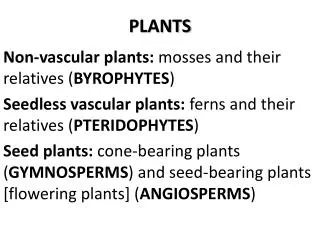
4 Major Groups- We will learn about 3 • Mosses & their Relatives- Non-vascular • Ferns and their Relatives • Cone-Bearing Plants- Gymnosperms 4. Flowering Plants- Angiosperms
Plant Life Cycle • Go through alternation of generations. • Two phases of their life cycle: sporophyte(2n = diploid) phase and gametophyte(n = haploid) phase • One part of the plant is haploid and one part is diploid
Non-Vascular Plants (like mosses) • Transport: specialized tissues and cells (diffusion, active transport) no vascular system! • Excretion: diffusion, active transport • Regulation: none • Respiration: guard cells, stomata • Nutrition: photosynthesis • Synthesis: eukaryotic organelles • Reproduction: alternation of generations (spores) Requires water!!! • Growth and Development: depend on water, grows low and short
Gymnosperms: cone-bearing plants • Transport: vascular tissue (xylem & phloem), roots, stems & leaves • Excretion: vascular tissue (xylem & phloem) • Regulation: plant hormones • Respiration: guard cells, stomata • Nutrition: photosynthesis • Synthesis: eukaryotic organelles • Reproduction: alternation of generations ; cones, pollen • Growth and Development: regular growth, need water, light, nutrients
Angiosperms: flowering plants • Transport: vascular tissue (xylem & phloem), roots, stems & leaves • Excretion:vascular tissue (xylem & phloem) • Regulation: plant hormones • Respiration: guard cells, stomata • Nutrition: photosynthesis • Synthesis: eukaryotic organelles • Reproduction: alternation of generations; flowers, which if fertilized turn into fruit (flowers have male and female parts!) • Growth and Development: regular growth, need water, light, nutrients
Plant vocab to add to your list! Plant responses: • Phototropism: grows towards light • Geotropism: • stems grow away from gravity • roots grow towards pull of gravity • Thigmotropism: plant grow in reponse to touch (ex. Vine)
Things to know for test (not on charts) • Feeding adaptations in plants and animals • Structural Reproductive adaptations • Internal fertilization eggs placenta • Adaptations to life on land (structural) • Ex. Legs, wings