Uncertainty and Risky Behavior
450 likes | 634 Views
Uncertainty and Risky Behavior. The Economics of Uncertainty. Utility is a function of income. The higher the level of income, the higher the level of utility. Decisions are based on expected utility, not expected income. Income and Utility. U. U. U.


Uncertainty and Risky Behavior
E N D
Presentation Transcript
Uncertainty and Risky Behavior Lectures in Microeconomics-Charles W. Upton
The Economics of Uncertainty • Utility is a function of income. • The higher the level of income, the higher the level of utility. • Decisions are based on expectedutility, not expected income. Uncertainty and Risky Behavior
Income and Utility U U U Rises more than proportionally: MU Increasing Rises in proportionMU Constant Rises less than proportionally:MU Declining I I I Uncertainty and Risky Behavior
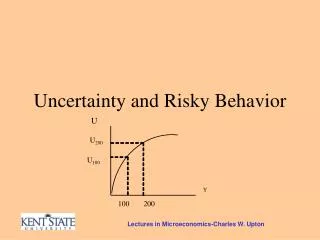
Risk Averter U U200 U100 Y 100 200 Uncertainty and Risky Behavior
Risk Averter U Here, utility is a function of income. But utility rises slower than income: MU is declining U200 U100 Y 100 200 Uncertainty and Risky Behavior
Risk Averter U Why do I draw this red line? Patience U200 U100 Y 100 200 Uncertainty and Risky Behavior
Risk Averter U Our individual is offered either $150k for sure or a 50-50 bet for $50k U200 U100 Y 150 100 200 Uncertainty and Risky Behavior
Risk Averter U If he passes on the bet E(U) = U150 U200 U150 U100 Y 150 100 200 Uncertainty and Risky Behavior
Risk Averter U If he takes the bet E(U) = 0.5U200 +0.5U150 U200 U150 U100 Y 150 100 200 Uncertainty and Risky Behavior
Risk Averter U E(U) is where the red line hits the expected income line U200 U150 U100 Y 150 100 200 Uncertainty and Risky Behavior
Risk Averter U U200 U150 Expected Utility U100 Expected Income Y 150 100 200 Uncertainty and Risky Behavior
Risk Averter U The geometry requires that the utility from the bet be less than the utility from the sure thing. U200 U150 Expected Utility U100 Expected Income Y 150 100 200 Uncertainty and Risky Behavior
Risk Averter U Don’t take bet. Expected utility is less than utility without bet. U200 U150 Expected Utility U100 Expected Income Y 150 100 200 Uncertainty and Risky Behavior
Risk Averter U Don’t take bet. Expected utility is less than utility without bet. U200 U150 Expected Utility Person is risk averter; will not take fair bet. U100 Expected Income Y 150 100 200 Uncertainty and Risky Behavior
A Digression • An individual is offered a bet. • If he loses, he gets income of IL. • If he wins, he gets income of IW. • The probability of winning is p • His expected income is (1-p)IL + pIW Uncertainty and Risky Behavior
A Digression • An individual is offered a bet. • If he loses, he gets income of IL. • If he wins, he gets income of IW. • The probability of winning is p • His expected income is (1-p)IL + pIW U((1-p)IL + pIW ))or (1-p)U(IL) + pU(IW)? Uncertainty and Risky Behavior
A Digression • An individual is offered a bet. • If he loses, he gets income of IL. • If he wins, he gets income of IW. • The probability of winning is p • His expected income is (1-p)IL + pIW If he is offered his choice between the bet or his expected income, which should he take? Uncertainty and Risky Behavior
A Digression U Plot IL, IW,U(IW), U(IL) UWin ULose Y IL IW Uncertainty and Risky Behavior
A Digression U Draw the red line; connect the dots. UWin ULose Y IL IW Uncertainty and Risky Behavior
A Digression U Find (1-p)IL + pIL UWin ULose Y IL IW Uncertainty and Risky Behavior
A Digression U Find the Utility with the expected income UWin U ULose Y IL IW Uncertainty and Risky Behavior
A Digression U Find the point where the blue income line hits the red line. UWin U ULose Y IL IW Uncertainty and Risky Behavior
A Digression U Draw a line to the utility axis. This gives us Expected Utility UWin U ULose Y IL IW Uncertainty and Risky Behavior
A Digression U Here, E(U) < U(Sure). Always true with diminishing MU UWin U ULose Y IL IW Uncertainty and Risky Behavior
Risk Neutrality U Utility rises in proportion to income U200 U100 Y 200 100 Uncertainty and Risky Behavior
Risk Neutrality U Find expected income, draw the red line U200 U100 Y 150 200 100 Uncertainty and Risky Behavior
Risk Neutrality U Draw the green dot; find expected utility U200 U150=E(U) U100 Y 150 200 100 Uncertainty and Risky Behavior
Risk Neutrality U Expected utility and utility from the sure thing are the same. U200 U150=E(U) U100 Y 150 200 100 Uncertainty and Risky Behavior
Risk Neutrality U Expected utility and utility from the sure thing are the same. U200 U150=E(U) Person is risk neutral. He is indifferent to fair bet. U100 Y 150 200 100 Uncertainty and Risky Behavior
Risk Taker U The last case: utility rises faster than income, MU is increasing U200 U100 Y 200 100 Uncertainty and Risky Behavior
Risk Taker U Draw the red line U200 U100 Y 200 100 Uncertainty and Risky Behavior
Risk Taker U Find Expected Income and Utility from the sure thing. U200 U150 U100 Y 200 100 150 Uncertainty and Risky Behavior
Risk Taker U Draw the green dot and find E(U) from the bet. U200 E(U) U150 U100 Y 200 100 150 Uncertainty and Risky Behavior
Risk Taker U Expected utility exceeds utility from the sure thing. U200 E(U) U150 U100 Y 200 100 150 Uncertainty and Risky Behavior
Risk Taker U Expected utility exceeds utility from the sure thing. This individual is a risk-taker. He will take the gamble. U200 E(U) U150 U100 Y 200 100 150 Uncertainty and Risky Behavior
The Three Cases • When utility rises less than income, we say the individual is a risk averter. • That is, he will avoid fair bets Uncertainty and Risky Behavior
The Three Cases • When utility rises less than income, we say the individual is a risk averter. • When utility rises faster than income, the individual is a risk-taker. • He will take fair bets Uncertainty and Risky Behavior
The Three Cases • When utility rises less than income, we say the individual is a risk averter. • When utility rises faster than income, the individual is a risk-taker. • When utility is proportional to income, the individual is risk-neutral • He is indifferent to fair bets Uncertainty and Risky Behavior
The Three Cases • Which one is most likely? Uncertainty and Risky Behavior
The Three Cases • Which one is most likely? • Some are risk takers, some are risk averters, and some are risk neutral. Uncertainty and Risky Behavior
The Three Cases • Which one is most likely? • Some are risk takers, some are risk averters, and some are risk neutral. • Butmost people are risk averters. Uncertainty and Risky Behavior
End ©2003 Charles W. Upton Uncertainty and Risky Behavior