Download
1 / 8
80 likes | 188 Views
Learn about translations, a type of geometric transformation that moves points of a figure the same distance and direction. Explore how to identify isometries, find images of translations, and write rules to describe translations. Practice with examples and graphs to enhance understanding.

E N D
Transformations • A transformation of a geometric figure is a change is the position, shape, or size. • In a transformation, the original figure is the preimage and the resulting figure is the image. • A transformation maps a figure onto its image; this is described with arrow notation and prime notation. • Here, ΔJKQΔJ’K’Q’ (or “ΔJKQ maps onto ΔJ’K’Q’ ”)
Identifying an Isometry • If the preimage and image are congruent, the transformation is an isometry.
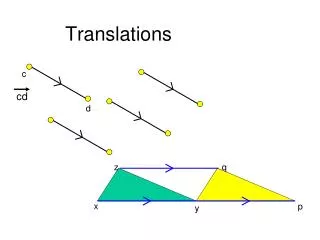
Translations • A translation is a transformation that maps all points of a figure the same distance in the same direction. • A translation is an isometry. • In the diagram, each point of the preimage was moved 4 units right and 2 units down to create the image. • Using variables, you could say that each (x, y) of the preimage is mapped to (x’, y’), where x’ = x + 4 and y’ = y – 2. • Using a translation rule, you would say: (x, y) (x + 4, y – 2).
Finding the Image of a Translation • What are the vertices of ΔP’Q’R’ given the translation (x, y) (x – 2, y – 5)? Graph ΔP’Q’R’. R Q P
What are the vertices of ΔA’B’C’ given the translation (x, y) (x + 1, y – 4)? Graph ΔA’B’C’. A B C
Writing a Rule to Describe a Translation • What is the rule that describes the translation PQRS P’Q’R’S’ ?
Given L(-6, -1), M(-4, -3), and N(-1, -1) and L’(1, -2), M’(3, -4), and N’(6, -2), what is the rule for the translation ΔLMN ΔL’M’N’?