Download
1 / 29
290 likes | 423 Views
This chapter explores the molecular basis of inheritance, focusing on DNA's structure and replication processes. It begins with historical landmarks in genetics, highlighting pivotal experiments by Griffith, Avery, Chargaff, Franklin, Hershey, and Chase, leading to the double-helix model proposed by Watson and Crick. The discussion covers the functions of enzymes such as helicase and DNA polymerase, the mechanisms of semi-conservative replication, the roles of leading and lagging strands, and the challenges of DNA replication, including error correction and the significance of telomeres in cellular aging. ###

E N D
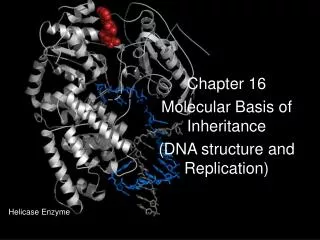
Chapter 16 Chapter 16 Molecular Basis of Inheritance (DNA structure and Replication) Helicase Enzyme
What is the genetic material? DNA or protein? The Amazing Race
1944 Avery – further studied transformation by destroying lipids, CHO, and proteins
1947 Chargaff – • Quantified purines and pyrimidines • Suggested base pairing rules (A=T, C=G)
1950 Wilkins and Franklin – DNA X-rays (a) Rosalind Franklin (b) Franklin’s X-ray diffraction photograph of DNA
1952 Hershey and Chase – bacteriophages – incorporation of radioactive viral DNA in new phages
EXPERIMENT Radioactive protein Phage Bacterial cell DNA Batch 1: radioactive sulfur (35S) Radioactive DNA Batch 2: radioactive phosphorus (32P)
EXPERIMENT Empty protein shell Radioactive protein Phage Bacterial cell DNA Batch 1: radioactive sulfur (35S) Phage DNA Radioactive DNA Batch 2: radioactive phosphorus (32P)
EXPERIMENT Empty protein shell Radioactivity (phage protein) in liquid Radioactive protein Phage Bacterial cell DNA Batch 1: radioactive sulfur (35S) Phage DNA Centrifuge Pellet (bacterial cells and contents) Radioactive DNA Batch 2: radioactive phosphorus (32P) Centrifuge Radioactivity (phage DNA) in pellet Pellet
1962 Nobel Prize awarded to Watson and Crick and Wilkins** Conclusion: DNA = Genetic Material, not Protein
Fun DNA Replication Facts • 6 billion bases in human cell = 2 hours of replication time • 500 nucleotides added per second • Accurate (errors only 1 in 10,000 base pairs)
Mechanism of Replication Step 1 • Origins of Replication= Special site(s) on DNA w/Specific sequence of nucleotides where replication begins • Prokaryotic Cells = 1 site (circular DNA) • Eukaryotic Cells = several sites (strands)
Steps 2 - 5 • Helicase: (enzyme) unwinds DNA helix forming a “Y” shaped replication fork on DNA • Replication occurs in two directions, forming a replication bubble • To keep strands separate, DNA binding proteins attach to each strand of DNA • Topoisomerases: enzymes that work w/helicase to prevent “knots” during unwinding.
Step 6 - Priming • Priming = due to physical limitation of DNA Polymerase, which can only add DNA nucleotides to an existing chain • RNA primase – initiates DNA replication at Origin of Replication by adding short segments of RNA nucleotides. • Later these RNA segments are replaced by DNA nucleotides by DNA Pol.
Step 7 • DNA Pol. = enzyme that elongates new DNA strand by adding proper nucleotides that base-pair with parental DNA template • DNA Pol. can only add nucleotides to the 3’ end of new DNA, so replication occurs from a 5’ to 3’ direction • Leading vs. Lagging Strand results
Leading vs. Lagging Strand • Leading Strand: strand that can elongate continuously as the replication for progresses • Lagging Strand: strand that cannot elongate continuously and moves away from replication fork. • Short Okazaki fragments are added from a 5’ to 3’ direction, as replication fork progresses.
5’ 3’ 5’ 3’ 5’ 3’ 3’ 5’
Step 8 • DNA Ligase = enzyme that “ligates” or covalently bonds the Sugar-Phosphate backbone of the short Okazaki fragments together • Primers are required prior to EACH Okazaki fragment
DNA i Flash Overview
Step 10: Fixing Errors • DNA Pol. Proofreads as it elongates • Special enzymes fix a mismatch nucleotide pairs • Excision Repair: • Nuclease: Enzyme that cuts damaged segment • DNA Pol. Fills in gap with new nucleotide
Mutations • Thymine Dimers (covalent bonding btwn Thymine bases) –often caused by over-exposure to UV rays DNA buckeling skin cancer results, unless corrected by excision repair • Substitutions: incorrect pairing of nucleotides • Insertions and Deletions: an extra or missing nucleotide causes “frameshift” mutations (when nucleotides are displaced one position)
Problems with Replication • Since DNA Polymerase can only add to a 3’ end of a growing chain, the gap from the initial 5’ end can not be filled • Therefore DNA gets shorter and shorter after each round of replication
Solution? • Bacteria have circular DNA (not a problem) • Ends of some eukaryotic chromosomes have telomeres at the ends (repeating nucleotide sequence that do not code for any genes) • Telomeres can get shorter w/o compromising genes • Telomerase = enzyme that elongates telomeres since telomeres will shorten
Telomerases are not in most organisms • Most multicellular organisms do not have telomerases that elongate telomeres (humans don’t have them) • So, telomeres = limiting factor in life span of certain tissues • Older individuals typically have shorter telomeres