Ensuring Workplace Safety: The Importance of Personal Protective Equipment (PPE)
190 likes | 415 Views
This document outlines essential information regarding Personal Protective Equipment (PPE) as mandated by OSHA standards (29 CFR 1910.132). It emphasizes the importance of identifying areas where PPE is needed and evaluating workplace safety hazards. Training objectives include employee participation in training sessions, proper use of PPE, and maintenance practices. Key types of PPE discussed include head protection, eye and face protection, body protection, hearing protection, and hand protection. Understanding these elements is critical for workplace safety and compliance.


Ensuring Workplace Safety: The Importance of Personal Protective Equipment (PPE)
E N D
Presentation Transcript
Personal Protective Equipment (PPE) OSHA requires the use of PPE when it is needed 29 CFR 1910.132 By: Chou Lor, Facilities Planning Management UW-Eau Claire Facilities Planning & Management
Personal Protective Equipment • Training Objectives • Identify areas where PPE may be needed • Employee participation • Identify different types of PPE • Care of PPE UW-Eau Claire Facilities Planning & Management
Personal Protective Equipment • Identify areas where PPE may be needed • Evaluate the work areas • What safety hazards are in the work areas? • The workplace conditions • Fall hazards • Evaluate the work task • What safety hazards does the task create? • What safety hazards do the tools and equipment pose? UW-Eau Claire Facilities Planning & Management
Personal Protective Equipment • Employee Participation • Attend required PPE training sessions • Wear PPE as required • Clean and maintain assigned PPE • Inform your immediate supervisor if PPE is in need of repair or replacement UW-Eau Claire Facilities Planning & Management
Personal Protective Equipment • Types of PPE • Head Protection • Head protection is important for many reasons • Head injuries are serious and some injuries may be permanent • Potential Hazards: • Falling objects • Electrical shocks • Splashes, spills, and drips UW-Eau Claire Facilities Planning & Management
Personal Protective Equipment • Head Protection Cont.: • Hard hats: Use rigid shell and suspension system to shield head. • Class A: Falling objects and electrical shocks – up to 2,200 volts. • Class B: Falling objects and electrical shocks– up to 20,000 volts. • Class C: Falling objects only. • Bump caps do not protect from falling objects. UW-Eau Claire Facilities Planning & Management
Personal Protective Equipment • Eye and Face Protection • Hazards associated with the eyes and face: • Flying objects • Splash hazards from chemicals, battery acid, degreasing, plating • Dusts or powders • Radiant energy – welding or lasers UW-Eau Claire Facilities Planning & Management
Personal Protective Equipment • Eyes and Face Protection Cont.: • Provide adequate protection. • Particles, liquids, vapors, gases, radiation • Safety Glasses with side shields, goggles, face shield • Reasonably comfortable. • Fit snugly, no interference to vision • Easily cleanable and durable. UW-Eau Claire Facilities Planning & Management
Personal Protective Equipment • Eyes and Face Protection Cont.: • Safety Glasses • Protects against • Moderate impact • Flying particles • Side Shields • Shatter-proof lenses • Impact-resistant frames UW-Eau Claire Facilities Planning & Management
Personal Protective Equipment • Eyes and Face Protection Cont.: • Safety Goggles: • Offer more protection than glasses. • Fit closer to the face. • Better protection when exposed to fumes, vapors, dusts, and splashing. • If used specifically for splash resistance, they must be labeled as so. UW-Eau Claire Facilities Planning & Management
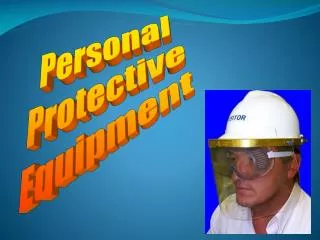
Personal Protective Equipment • Eyes and Face Protection Cont.: • Face Shield • Offer full face protection • Used in operations that produce flying objects or splashes • Can be worn with a hard hat • Must be worn with safety glasses • Face shields alone are not adequate eye protection UW-Eau Claire Facilities Planning & Management
Personal Protective Equipment • Body Protection • Body Hazards • Extreme temperatures • Chemical exposure • Impact • Falls • Electrical contact • Entanglement UW-Eau Claire Facilities Planning & Management
Personal Protective Equipment • Body Protection Cont.: • Suits • Gas/vapor-tight • Liquid-tight • Particulate-tight • Partial body/limited • Aprons and sleeves • Chaps, knee pads, shin guards • Appropriate attire • no loose clothing • non-melting material UW-Eau Claire Facilities Planning & Management
Personal Protective Equipment • Hearing Protection • Exposure to excessive noise levels (8 hour TWA> 85dBA) • Decide which size and type protector is most suitable for the working environment. • Must adequately reduce the severity of the noise level for each employee’s work environment. • Types of ear protection available include: • Jazz Band • Earmuffs • Earplugs UW-Eau Claire Facilities Planning & Management
Personal Protective Equipment • Hand Protection • Protects against risk of • Cuts • Abrasions • Burns • Punctures • Exposure to hazardous materials. • Requires selection of the appropriate gloves for the job. UW-Eau Claire Facilities Planning & Management
Personal Protection Equipment • Hand Protection Cont.: • How to remove gloves • Grasp the outside of one glove. • Hold the glove with your gloved hand. • Insert your fingers on the inside of the glove. • Turn the glove inside out over the first glove UW-Eau Claire Facilities Planning & Management
Personal Protective Equipment • Foot Protection • Foot Hazards: • Danger of foot injuries due to falling and rolling objects, • Slip hazards or objects piercing the sole, • Where employees are exposed to electrical hazards. • Safety shoes or boots with impact protection are required for: • Carrying or handling heavy materials such as: • Packages, objects, parts or tools, which could be dropped and for other activities where objects might fall onto the feet. UW-Eau Claire Facilities Planning & Management
Personal Protective Equipment • Foot Protection Cont.: • Special situations may require wearing metatarsal protection, electrical conductive or insulating safety shoes or boot. • Must comply with ANSI Z41-1999 Standards. UW-Eau Claire Facilities Planning & Management
Personal Protective Equipment • Care of PPE • Always check PPE for damage before and after each use • Clean PPE before storing • Dispose of and replace damaged PPE • Store PPE properly and avoid conditions that could damage it, such as heat, light, moisture, etc. UW-Eau Claire Facilities Planning & Management