Download
1 / 44
440 likes | 531 Views
Understand how cells obtain, store, and use energy through photosynthesis and cellular respiration processes. Photosynthesis converts sunlight into food energy, while respiration releases ATP energy within cells. Explore the chemical reactions involved in glucose production and energy transformation from sunlight to chemical energy. Discover the vital roles of chlorophyll, the Calvin cycle, and aerobic respiration in generating ATP for cellular functions. Learn about the differences between aerobic and anaerobic respiration and the efficiency of ATP production. Master the steps of glycolysis, the Krebs cycle, and the electron transport chain within mitochondria. Enhance your knowledge of energy-storing compounds like ATP and the essential functions they serve in sustaining cellular processes.

E N D
Energy: • All living things must obtain and use energy E • Energy cannot be created nor destroyed • Energy can be transformed
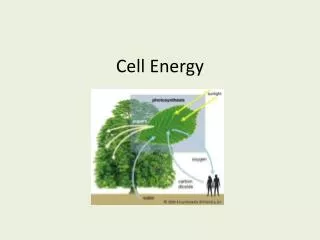
Energy (cont). • The only constant source of energy for the earth is the sun • Almost all living cells depend on the sun for energy either directly or indirectly.
Glucose and the cell: • C6H12O6 • Glucose is the final product of photosynthesis • Glucose is used by most living cells as the primary food molecule.
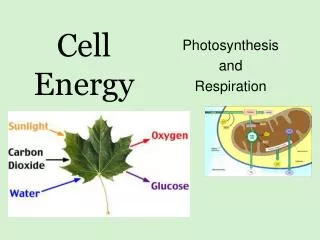
Chemical Reaction of Photosynthesis: 6CO2 + 6H2O + LIGHT C6H12O6 + 6O2
Photosynthetic Organisms: • Autotrophs or Producers convert the E in sunlight to chemical E in food (sugar)
Autotrophs: • Examples of autotrophs include: Plants, algae, and some bacteria. b/g algae algae Plant
Autotroph • Auto ---- “self” • Troph ---- “feeder” • Autotrophs produce their own food, and are the basis for the food chain.
Photosynthesis: • Stores light E in the chem bonds of sugar: 6CO2 + 6H2O + LIGHT C6H12O6 + 6O2
Photosynthesis • The in the reaction represents many intermediate steps. • Two main categories: • lightreactions- trapping E from sunlight • darkreactions- storing E in sugars
Chlorophyll • Chlorophyll- the material that allows plants to trap the E from sunlight. • Chlorophyll absorbs blue and UV light, and red light. • Chlorophyll reflects green, and most yellow light
Photosynthesis • Takes place in the chloroplasts • Light Reactions occur in the thylakoids • Dark Reactions occur in the stroma
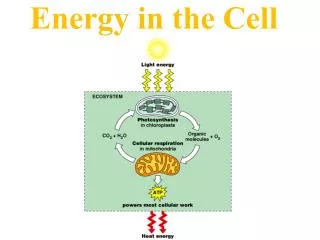
H2O CO2 Light Dark Reactions Light Reactions O2 Glucose
Light Reactions • Process by which the energy from sunlight is captured by chlorophyll. (in the thylakoid membrane) • O2 is given off as a byproduct
Dark Reactions (aka Calvin Cycle) • Process by which energy from the light reactions and CO2 are used to build glucose molecules. • C6H12O6
THE GOAL: TO PRODUCE ATPFOR USE WITHIN THE CELL!
Energy Storing Compounds • Starches, sugars, even gasoline are E-storing compounds • Principle E-storing compound for the cell is ATP
ATP • “Adenosine Triphosphate“ • Made up of • Adenine (nitrogenous base) • Ribose (5-C sugar) • Three phosphates
ATP • Energy is stored when phosphates are added • ADP + P (+ energy) ATP • Energy is released when phosphates are removed • ATP ADP + P (+ energy)
Cellular Respiration • Catabolism is breaking down chemicals into their parts • Cellular Respiration is catabolism that releases energy for use in the cell (ATP) • Can be Aerobic (with O2), or Anaerobic (without O2)
Aerobic Respiration C6H12O6+O2CO2+H20 + (E) Energy is released from the sugar in the form of ATP for use within the cell.
Aerobic Respiration • Requires the presence of O2 • Extremely efficient • produces approx. 36 ATP per glucose molecule
Steps of Aerobic Respiration: 1. Glycolysis 2. Krebs Cycle 3. Electron Transport Chain (ETC)
Glycolysis • Takes place in the cytoplasm • “Glyco” meaning “sugar” • “lysis” meaning “to break” • Glucose molecules are broken down into pyruvic acid which will then enter the Krebs cycle
Krebs Cycle
Krebs Cycle • Takes place in the matrix of the mitochondria • Pyruvic acid from glycolysis is broken down to produce high energy molecules(NADH and FADH2 - which go to the ETC) • CO2 is given off as a byproduct
Mitochondrion Matrix
Electron Transport Chain
Electron Transport Chain (ETC) • Like the Krebs Cycle, ETC takes place in the mitochondria • Specifically, the ETC occurs in the Inner Membrane and the Intermembrane Space of the mitochondria.
Mitochondrion Inner Membrane
Mitochondrion Outer Membrane
Mitochondrion Intermembrane Space
ETC cont. • Folds and projections called crista (cristae) in the inner membrane of the mitochondria increase the surface area available for the reactions.
Mitochondrion Crista
ETC cont. • Most of the ATP from Aerobic Respiration is generated by the Electron Transport Chain • This series of reactions converts the high energy molecules from the Krebs Cycle into ATP for use in the cell • Oxygen is required
Anaerobic Respiration
Anaerobic Respiration • Takes place when O2 is not present. • Far less efficient than aerobic respiration • produces approx. 2 ATP per glucose molecule