Games@Large
This experimental design proposal examines how system performance, hardware features, and latency influence player experience in video games. The study will involve 80 participants engaging with different games (Total Overdose, Sprill, Majong) on various systems and input devices (notebook vs. set-top box). By assessing the impact of latency thresholds on game experience, this research aims to provide insights into optimizing the gaming experience. The method involves between-subjects and within-subjects design across multiple sessions, followed by rigorous data analysis and reporting.

Games@Large
E N D
Presentation Transcript
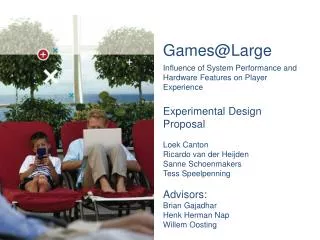
Games@Large Influence of System Performance and Hardware Features on Player Experience Experimental Design Proposal Loek Canton Ricardo van der Heijden Sanne Schoenmakers Tess Speelpenning Advisors: Brian Gajadhar Henk Herman Nap Willem Oosting
Games@Large Project Theory Method Planning
Games@Large Project Theory Method Planning
Games@Large Project Play video games anytime, anywhere Latency Player experience Hardware & games Image from: Games@Large – Envisioning the Future of Video Game Entertainment Delivery. Technical Brochure Images from: Fritsch, T., Ritter, H and Schiller, J. (2005). The Effect of Latency and Network Limitations on MMORPGs
Games@Large Project Theory Method Planning
Theory Previous research Game experience & immersion MOS & GEQ Image from: Claypool, M. & Claypool, K. (2006). On Latency and Player Actions in Online Games. Image from:Dick, M., Wellnitz, O. and Wolf, L. (2005). Analysis of Factors Affecting Players’ Performance and Perception in Multiplayer Games.
Games@Large Project Theory Method Planning
Method Hypothesis: There will be a different threshold of latency for each system, game and device where the game experience starts to decrease. - 125ms for Total Overdose* - 500ms for Sprill* - 1000ms for Majong* * Based on previous research
Method Dependent variable: - game experience Independent variables: - latency (to be defined) - Game (Sprill, Majong, Total Overdose) - System (notebook, PC) - Input device (mouse, gamepad) - Score - Playability
Method Design: - Between subjects: - notebook vs. set-top box - Within subjects: - game vs. device vs. latency
Method 2 sessions: Participants are asked to come back Total number of participants: 80 Game A is most critical, B and C are less critical
Method Example:
Games@Large Project Theory Method Planning
Planning 16/3 – 27/4: experiments 27/4 – 25/5: analyzing 25/5 – 5/6: report & paper