Quick-Service Foods Sector
240 likes | 446 Views
Quick-Service Foods Sector. Compiled By: Laura Keller Stephanie Latimer Nate Tuenge Steven Austed Shelly LiaBraaten Aaron Lum. Sector Definition. Commercial restaurant service comprises everything from restaurants and cafeterias to ice cream parlors, bars, and cafes


Quick-Service Foods Sector
E N D
Presentation Transcript
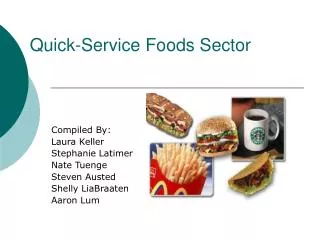
Quick-Service Foods Sector Compiled By: Laura Keller Stephanie Latimer Nate Tuenge Steven Austed Shelly LiaBraaten Aaron Lum
Sector Definition • Commercial restaurant service comprises everything from restaurants and cafeterias to ice cream parlors, bars, and cafes • Focus on limited-service restaurants which offer rapid food preparation and low prices, with or without seating. The average check price is usually less than $7.
Sector’s Dominate Traits(AKA Fun with Statistics) • Market Size: $128.2 billion, 28.2% of total foodservice sales • Market Growth Rate: 4.2% in 2003 and slowing
Fun with Statistics continued.. • Industry Profitability:
Fun with Statistics continued.. • Stage in the Growth Cycle: Maturing industry, focusing on growing same-store sales • Capital Requirements: High fixed costs. Food & beverages, labor, and real estate top costs • Focus on Product innovation • Prevalence of integration: Stores integrating into quick-service (Delis) • Rivalry: Highly competitive market, several companies vying for our meal dollars
Competitive Forces • Food Prices Supply Shock & Fuel Costs • Product Differentiation Price Discounting vs. Innovation • Government Regulation Smoking & Minimum Wage “Beef it’s what's for dinner”-(US) Cattlemen's Beef Board
Industry Expected to Grow • Growing Industry – more people are eating out than ever before • 2003 – 46.9% of meals away from home • 2010 – will spend 53% of meals away from home
Industry Expected to Grow (continued) • Why are Americans spending more money on meals away from home? • Decline in cost difference between eating out and eating in • 2002 – only cost 25% more to eat at a restaurant • Less free time • 2003 – over 50% of U.S. families were dual-earner households • More disposable income • Aging baby boomers are progressively wealthier • 1999 to 2004 – real disposable income increased at 1.8% per year
Shift in Industry Focus:From Discounting to Innovation • Price Wars of 2000 - 2002 • Saturated markets resulted in fierce competition between rivals (McDonald’s vs. Burger King) • To compete for the economically downtrodden customer base, major competitors drastically lowered prices ($0.99 value menus) • Discounting greatly hurt profitability – not a sustainable strategy
Shift in Industry Focus:From Discounting to Innovation (continued) • Product Innovation – 2003 • Mimicked the success of the new “quick-casual” concept – higher quality, higher prices • At fast-food restaurants, sales grew 5.4% in 2003 • Found that people are willing to pay more for quality products • Health food craze
Future Focus • Less emphasis on U.S. expansion and price discounting • Continued focus on product innovation and current store improvements • Remodeling stores to improve image • Wendy’s, McDonald’s, and Jack in the Box have announced accelerated remodeling plans for 2005
International Expansion: China • U.S. fast food market is saturated and firms are looking to expand abroad • Large Chinese market • 25% of World’s population • KFC – rated #1 consumer brand in China • McDonald’s and Starbuck’s plan to focus their international expansion on China over the next several years • Hoping to establish themselves in the market by the 2008 Beijing Olympics
Strong companies • McDonald’s Corporation • Aroma Café, Boston Market, Chipotle Mexican Grill • Panera Bread Co. • Was known as St. Louis Bread Company • Wendy’s International • Baja Fresh, Tim Hortons, Café Express, Pasta Pomodoro
McDonald’s Corporation • Strong brand name • Worldwide presence • 18,000 stores • Mixes McDonald’s American style with local tastes • Systemwide sales of $4.2 billion • “As a condition of the franchise agreement, McDonald's owns the property on which most McDonald's franchises are located.”
Panera Bread Co. • Systemwide sales of nearly $1 billion in 2003 • Second fastest growing chain in 2004 • Stores in 35 states • Moved into the quick-service market before many of the others did • “There are currently 656 Wi-Fi enabled Panera Bread bakery-cafes, from California to Virginia.”
Wendy’s International • Systemwide sales of $11.6 billion • Restaurants in the US and Canada • 6000 • Different restaurant segments are broken up
What key factors will determine competitive success or failure? • Following Demographics • Understanding the economy • International Markets
Following Demographics • Chiptole Mexican Grill (McDonald’s Corp.) • Baja Fresh (Wendy’s International) • Qdoba (Jack In a Box)
Understanding the Economy • Economic Recession: • Promoting a more positive supply / demand relationships, which resulted in a stable sales growth • Economic Boom: • Focus capital expenditures on new units, focus on new products
Industry Attractiveness • Industry attractive to investors, especially franchising • Industry very profitable, and expected to keep growing because of increases in disposable income and dual worker homes • Low barriers to entry, but intense competition and high fixed costs cause many ventures to fail
Sources • Restaurant Research: Operators Focusing on Same-Store Sales - May 2005 - Franchising World - Franchising World - International Franchise Association • Industry Trends: Restaurants • Industry Profile: Restaurants • How the Industry Operates: Restaurants
Sources • Milton, Dennis P.; Standard & Poor’s Industry Surveys: Industry Trends - Restaurants; 21 April 2005; http://0-www.netadvantage.standardandpoors.com.oasis.oregonstate.edu/docs/indsur/rst_0405/rst20405.htm#trends. • Milton, Dennis P.; Standard & Poor’s Industry Surveys: Current Environment - Restaurants; 21 April 2005; http://0-www.netadvantage.standardandpoors.com.oasis.oregonstate.edu/docs/indsur/rst_0405/rst_0405.htm#environ. • Milton, Dennis P.; Standard & Poor’s Industry Surveys: Industry Profile - Restaurants; 21 April 2005; http://0-www.netadvantage.standardandpoors.com.oasis.oregonstate.edu/docs/indsur/rst_0405/rst10405.htm#profile. • Milton, Dennis P.; Standard & Poor’s Industry Surveys: How the Industry Operates - Restaurants; 21 April 2005; http://0-www.netadvantage.standardandpoors.com.oasis.oregonstate.edu/docs/indsur/rst_0405/rst30405.htm#operates. • Restaurant Research: Operators Focusing on Same-Store Sales - May 2005 - Franchising World - Franchising World - International Franchise Association • http://quotes.nasdaq.com/quote.dll?mode=basics&kind=&timeframe=10y&intraday=off&charttype=ohlc&splits=off&earnings=off&movingaverage=None&lowerstudy=volume&comparison=on&index=&symbol=WEN&symbol=MCD&symbol=PNRA&symbol=&symbol=&symbol=&symbol=&symbol=&symbol=&symbol=&FormType=&mkttype=&pathname=&page=charting&selected=PNRA • http://en.wikipedia.org/wiki/Mcdonald%27s
Image Sources • http://timmyray.typepad.com/timmy_ray/weird/ • http://www.6foot6.com/fr/agfaimages/china/ChBeijing_BrandKFC.jpg • http://www.dw-world.de/dw/image/detail/1,1599,1076556_3,00.html • http://www.mccscamppendleton.com/clubs/fast_food/fast_food.html • http://www.mcdonalds.com/usa/eat/features.html • http://www.starbucks.com/aboutus/internationaldev.asp • http://www.wendys.com/food/Family.jsp?family=4 • www.google.com