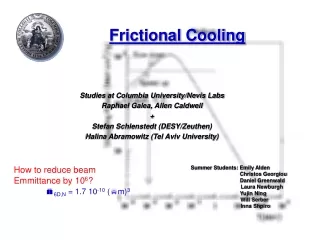
Frictional Cooling
This paper discusses the innovative approach of frictional cooling as a means to enhance muon beam production for future muon colliders. Unlike traditional methods, frictional cooling utilizes the properties of muons at high energies to maintain efficiency while minimizing energy loss in interactions with matter. The proposed methods involve the use of solenoidal magnets and specific target systems to optimize the yield and phase space of the muon beams. The findings address potential challenges and propose solutions for efficient muon cooling and production.

Frictional Cooling
E N D
Presentation Transcript
FNAL-27-10-2009 Frictional Cooling Caldwell MPI f. Physik, Munich
compared to protons: • colliding point particles rather than complex objects antiquark gluon quark Motivation: Muon Collider • compared to electrons: • no synchrotron radiation problem P (E/m)4 • very high energy circular accelerator can be built Allen Caldwell
Drift region for decay 30 m ’s ’s Proton beam Solenoidal Magnets: few T … 20 T Target after drift estimate beam description using 6D emittance (6D phase space of the beam) rms:x,y,z 0.05, 0.05, 10 m px,py,pz 50, 50, 100 MeV 6D,N 1.710-4 (m)3 required COOLING 6D,N 1.710-10 (m)3 beam production Allen Caldwell
Proton accelerator – 2-16 GeV, few MW (1022 p/year) production target decay channel cooling channel accelerators Muon collider Typical muon collider scheme • standard techniques too slow • new techniques are being developed • energy loses in interactions with matter • reaccelerating • magnetic focusing Allen Caldwell
big issue – how to maintain efficiency • similar idea first studied by Kottmann et al. at PSI Frictional cooling Idea • bring muons to kinetic energy T where dE/dx increases with energy • apply constant accelerating E field to muons resulting in equilibrium energy Equilibrium energy Allen Caldwell
apply EB to get below the dE/dx peak Frictional cooling Problems/Comments • large dT/dx at low T • low average density of stopping medium gas E vB • slow ’s don’t go far before decaying • with T in eV • sideward extraction (EB) • + problem – muonium formation dominates over e-stripping except for He • – problem – muon capture at low energies; not known • keep T as high as possible Allen Caldwell
Neutralization Stripping For , energy lower by M/MP From Y. Nakai, T. Shirai, T. Tabata and R. Ito, At. Data Nucl. Data Tables37, 69 (1987) Allen Caldwell
Frictional Cooling: particle trajectory ** Using continuous energy loss Allen Caldwell
cooling cell target phase rotation capture & drift reacceleration Simulations performed to this point collider ring Full MARS simulation of the proton interactions in target (Cu) showed • He gas used for + • H gas for – • transverse E field 5 MV/m • continuous electronic energy loss • individual nuclear scatters simulated • they result in large angles • larger low energy yield in transverse directions • nearly equal + and – yields with T < 100 MeV Muon collider scheme based on frictional cooling Not to scale !! Allen Caldwell
Target System • cool m+ & m- at the same time • calculated new symmetric magnet with gap for target GeV Allen Caldwell
Full MARS target simulation, optimized for low energy muon yield: 2 GeV protons on Cu with proton beam transverse to solenoids (capture low energy pion cloud). Allen Caldwell
Target & Drift Optimize yield • Optimize drift length for m yield • Some p’s lost in Magnet aperture Allen Caldwell
Phase Rotation • First attempt simple form • Vary t1,t2 & Emax for maximum low energy yield Allen Caldwell
Cooling cell simulation He gas is used for +, H2 for -. • Individual nuclear scatters are simulated – crucial in determining final phase space, survival probability. • Incorporate scattering cross sections into the cooling program • Include m- capture cross section using calculations of Cohen (Phys. Rev. A. Vol 62 022512-1) • Electronic energy loss treated as continuous Allen Caldwell
Scattering Cross Sections • Scan impact parameter and calculate q(b), ds/dq from which one can getlmean free path • Use screened Coulomb Potential(Everhart et. al. Phys. Rev. 99 (1955) 1287) • Simulate all scatters q>0.05 rad • Simulation accurately reproduces ICRU tables for protons Allen Caldwell
Barkas Effect • Difference in m+ & m- energy loss rates at dE/dx peak • Due to charge exchange for m+ • parameterized data from Agnello et. al. (Phys. Rev. Lett. 74 (1995) 371) • Only used for the electronic part of dE/dx Allen Caldwell
rms. Oscillations around equilibrium define the emittance Simulation of the cooling cell Allen Caldwell
Resulting emittance and yield Muon beam coming out of 11 m long cooling cell and after initial reacceleration: rms:x,y,z 0.015, 0.036, 30 m px,py,pz 0.18, 0.18, 4.0 MeV Results for +, still working on - 6D,N 5.710-11 (m)3 • better than required 1.710-10 (m)3 • Yield 0.002 per 2 GeV proton after cooling cell • need improvement byfactor of5 or more Allen Caldwell
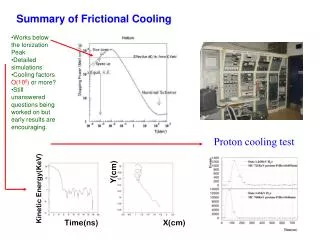
Future plans • run the experiment – demonstrate the frictional cooling Develop scheme for producing slow muon beam using surface muon source (paper in preparation) Allen Caldwell