Understanding Forces: Analyzing Various Physical Scenarios Through Free Body Diagrams
This guide explores different physical scenarios presented through Free Body Diagrams (FBDs), showcasing the balance of forces acting on objects. Each scenario illustrates fundamental concepts in mechanics, including static equilibrium, acceleration, and the role of friction. The analysis covers a range of situations, such as a book at rest, a free-falling egg, and a girl holding a rope. Through these examples, students will gain a deeper understanding of how forces interact in real-world contexts and the importance of accurately analyzing forces using FBDs.

Understanding Forces: Analyzing Various Physical Scenarios Through Free Body Diagrams
E N D
Presentation Transcript
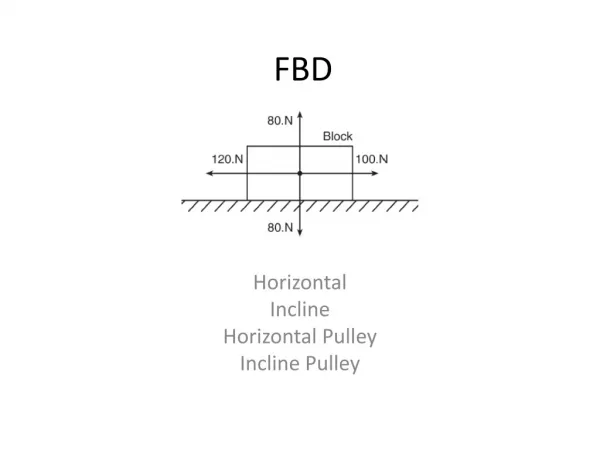
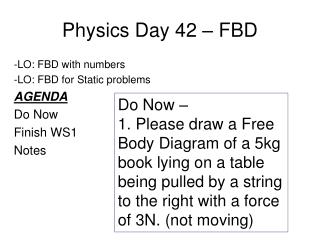
1. Book at rest on table FN ΣFy = may FN – Fg = 0 Fg
2. Girl holding rope T ΣFy = may T – Fg = 0 Fg
3. Free Falling Egg ΣFy = may – Fg = may Fg
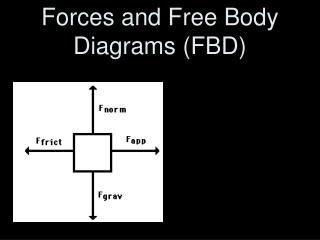
4. Book accelerating to right ΣFy = may FN – Fg = 0 ΣFx = max FA – f = max FN FA f Fg
5. Book across desk at constant v ΣFy = may FN – Fg = 0 ΣFx = max FA – f = max FA – f = 0 FN FA f Fg
6. Sled with acceleration left ΣFy = may FN – Fg = 0 ΣFx = max f - FA = max FN FA f Fg
7. Football near peak of flight ΣFy = may – Fg = may Fg
8. Car coasting right but slowing down ΣFy = may FN – Fg = 0 ΣFx = max – f = max FN f Fg
9. Shopping cart with 40° push down and to right moving at constant speed ΣFy = may FN – Fg – FAsin40 = 0 ΣFx = max FAcos40 – f = max FAcos40 – f = 0 FN f 40 ° FA Fg
10. Sled accelerated left by pull at 30° above horizontal ΣFy = may FN – Fg + FAsin30 = 0 ΣFx = max -FAcos30 = max FA FN 30° Fg
Try it… • 1. A shuffleboard puck slowing to a stop as it slides across the court • 2. A crate pulled at a constant speed to the left by a rope that makes a 25 degree angle with the horizontal