Download
1 / 9
100 likes | 228 Views
This study presents the calibration of three pyrgeometers (PIRs) against the WISG reference at Davos, using a regression technique. The calibrations were conducted outdoors over several weeks, comparing the triad average against various regression methods, including those by Cox & Albrecht, Reda et al., and Philipona. The results indicate that assuming the WISG is an absolute reference, Cox and Albrecht yield uncertainties of 3-4 W/m², while Reda et al. and Philipona achieve approximately 1.25 W/m² uncertainties with no significant diurnal variations.

E N D
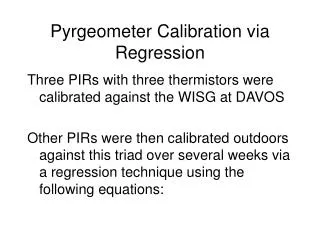
Pyrgeometer Calibration via Regression Three PIRs with three thermistors were calibrated against the WISG at DAVOS Other PIRs were then calibrated outdoors against this triad over several weeks via a regression technique using the following equations:
Comparison of Triad Average vs Cox & Albrecht Regression Calibration of PIR
Comparison of Triad Average vs Reda et al. Regression Calibration of PIR
Comparison of Triad Average vs Philipona Regression Calibration of PIR
Conclusions • Assuming the WISG is an absolute reference - Cox and Albrecht produce 2 uncertainties of 3-4 Wm-2 with noticeable diurnal differences - Reda et al. or Philipona produce 2 uncertainties of 1.25 Wm-2 with no large diurnal differences • A problem (Forgan comment) is that the values of these regressed coefs differs significantly from the blackbody+oudoor calibration