Download
1 / 37
370 likes | 486 Views
Explore the importance of MFI-5 in process model registration, focusing on enhancing semantic interoperation and supporting integration within organizations within the context of the evolving software paradigm. Learn about the scope, specifications, and future work areas of MFI-5 in facilitating harmonious and effective web service composition.

E N D
MFI-5: Metamodel for process model registration Chong Wang, Keqing He and Baba Piprani
Content • Why we need MFI-5 • MFI and MFI-5 • Introduction of MFI-5 • Future work
Content • Why we need MFI-5 • MFI and MFI-5 • Introduction of MFI-5 • Future work
Semantic Service-Oriented Architecture (NLL, OWL(-s), UBL,…) Semantic Web Service Service-Oriented Architecture (XML,SOAP,HTTP, …) Web Service Middleware (CORBA,J2EE…) Messages Component Object Evolution of Software Paradigm (1/2) Granularity of Software Modular Time 1990’s 21 Century 1980’s
Evolution of Software Paradigm (2/2) • Web Services (WS) can be deemed as • Basic modular for software development • Popular form of web-based applications • Specification related to different aspects of WS • Service Oriented Architecture (SOA) • Description languages: OWL-s, WSDL,… • Web Services registry mechanism: UDDI • …… • Web service is a kind of process model
What is Process • Process is defined as • a set of work items, scheduled according to constraints, which all participate in fulfilling a common purpose. [Breton, 2001] • transformation of input to output. [ISO/IEC 12207] • Structured set of activities involving various enterprises entities, that is designed and organized for a given purpose. [ISO 18629-1, 2004] • one or more activities that occurs over a period of time in which objects participate. [Cutting-Decelle Anne-Francoise, 2005 ]
What is Process Model • Process models are • carriers of process knowledge, concerning how to do things [John, 2006] • the products of process modeling that is described with a certain process modeling language • In general, process models are deemed as a special kind of information model with behavioral features • State transfer • Data exchange • …… include • Web services, business process, workflow, etc.
? ? ? How to make them work together in a harmonious and effective way? Why we need MFI-5 (1/3) • Business cooperation and web service composition are more and more popular in current practice within/across enterprises. Purpose/Objective Activities Steps/Orchestration Actors & Roles
Personalized Requirements expressedAs Goal achievedBy partOf partOf Process partOf partOf interoperate achievedBy achievedBy Process 1 Process 2 Goal 2 Goal 1 Different expressions, formats and implementation details Why we need MFI-5 (2/3) Registration is the basis of interoperationand further integrationof process models.
Why we need MFI-5 (3/3) • MFI family focuses on the various kinds of information resources • MFI Core provides a very generic framework for various models. • Insufficient to deal with input and output messages, which are the basic component of process model • MFI Ontology Registration • provides a facility to register administrative and evolution information of ontologies. • A new part is needed to enable interoperation between process models and support further customized construction based on them. • Problems to be tackled in MFI-5 is to provide a facility to register the administrative information about process models • Structural info • Semantics
Content • Why we need MFI-5 • MFI and MFI-5 • Introduction of MFI-5 • Future work
ISO/IEC 19763 (Metamodel Framework for Interoperability) MOF & ISO 11179(MDR) MFI Core Model Metamodel for Ontology Registration Metamodel for Model Mapping Metamodel for ProcessModel Registration Interoperability Exchanging Metamodel Instance UOD-y UOD-x Universal Of Domain
MFI Core & MFI-5 from MFI Core
Content • Why we need MFI-5 • MFI and MFI-5 • Introduction of MFI-5 • Future work
Scope of MFI-5 (1/3) • Objective • Provide a metamodel to register process models, including business process model, web service and so on. • Focus on the relationship between process model described with different process description languages, especially the composite process consists of sub-processes expressed in different languages. • Promote semantic interoperation between various process models. • Support process integration within/across organizations
MFI Core Scope of MFI Process registration MFI Ontology Registration Scope of MFI-3 MFI Process registration Admin. Info. A Admin. Info. B Ontology registry Process model registry Administrative information of process model A Administrative information of process model B referredTo Process model repository Process model A for application system A Process model B for application system B support Application system B Application system A interoperation Scope of MFI-5 (2/3) Specifications such as PSL
Scope of MFI-5 (3/3) • Points in the scope of MFI-5 • Structural information of process model • Which sub-processes are contained in process model • Which artifact participate in fulfilling the common purpose • Semantic constraints of process model • Semantic relation/contradiction between artifacts • Condition • Mandatory sequence • Precondition and postcondition • …… • Outside the scope of MFI-5 • Language specific details • Implementation level details
Structural Info Process model expressed in different modeling languages Semantic Info • Actual execution • 12(2.12.2)3 • Control_Constraint • Condition: precondition/postcondition • Control Construct: Sequence 2(2.12.2)3 CP 1 3 2 AP1 CP1 AP2 2.1 2.2 abstract AP3 AP4 Output1 • Artifact_Constraint: semantic consistency between artifacts carried by Input/Output CP1 Output3 Input2 Ontology Output1 Input1 AP3 Input1 Output2 Input3 supports Input2 Output3 AP4 Basic idea of MFI-5
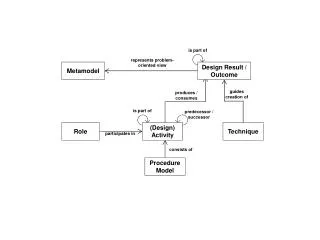
Base Model Process Control Model Overview of MFI-5 MFI-5
Base Model (1/2) • Base Model is proposed to register structure information of various process models • Goal: the purpose that should be achieved by fulfilling the process model • Artifact: the resources that participate in the process, which can be carried by its Inputs or Outputs • Atomic Process: the process model characterized with the smallest granularity and one-step execution • Composite Process: the complicated process model which is composed of at least two sub-processes.
Process Control Model (1/3) • Process Control Model is defined to record two kinds of control constraints in process models • Artifact_Constraint • Added to Artifact • From registration info of ontologies based on MFI-3 • Usage • establish a semantic bridge between different Artifacts • support input/output matching between different process models • Semantically annotate specified Artifact • avoid semantic confliction during process integration
Process Control Model (2/3) • Control_Constraint • Added to Process • Consists of • The conditions that should be satisfied before or after execution of the process model • The sequence followed by the sub-processes • Specially the conditions carried by control constructs, which are used to connect the sub-processes.
Fragment of top level process for manufacturing a GT350* Composite Process …… * from Annex C of ISO 18629-12
based on Process Control Model (Control Constraint) based on Base Model Registration Info of manufacturing GT350 (1/2)
Manufacturing the 350-Engine Fragment of manufacturing sub-process Manufacturing the 350-Block Atomic Process
based on Process Control Model (Control Constraint) based on Base Model Registration Info of manufacturing GT350 (2/2)
Summary of Case Study • MFI-5 can be used to register administrative information of process models described with different languages • OWL-s, PSL, …… • However, considering real interoperation between process models, we need not only • Registration info based on MFI-5 but supplement relevant information, including • Mappings between specified modeling languages • Implementation details • ……
Content • Why we need MFI-5 • MFI and MFI-5 • Introduction of MFI-5 • Future work
Future work • MFI-5 • Improve two models in detail • Validation of 19763-5 • Get CD resolution in Sydney meeting • Applications • Logistics distribution domain • Urban transportation domain (ongoing) • ……