Analysis Procedures
This document outlines the essential procedures for conducting mission and function analyses in system requirements determination. It emphasizes the importance of understanding specific goals, required outputs, and system capacities while considering operating environmental factors and constraints. Analysts and designers are guided through decomposition of tasks, identification of functions, and establishment of functional performance criteria. Tools for mission analysis, such as mission profile graphics and scenario descriptions, are highlighted, along with the critical evaluation of human factors, workload implications, and design requirements.

Analysis Procedures
E N D
Presentation Transcript
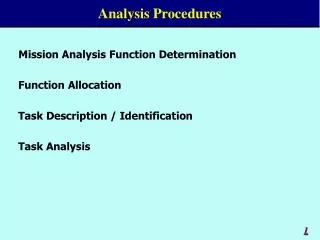
Analysis Procedures • Mission Analysis Function Determination • Function Allocation • Task Description / Identification • Task Analysis
Mission Analysis (System Requirements Analysis) • What is the system supposed to accomplish? • The analyst/designer needs to know - • Specific Goals • Required Outputs • Required Inputs • System Capacities and Performance Requirements • Operating Environmental Factors • Constraints on System Operation
Mission Analysis Tools • Mission Profile Graphic Description (Example - Flight Profile) • Mission Scenario Verbal Description - Summarizes typical assumptions, environments, operations. • Mission Segment Time period of coherent activities with definite beginning and ending points.
Importance of Function & Task Analyses • Evaluate Human Factors Implications • Design Requirements and Constraints • Workload Implications • Notes: • 1. Decompose to level where functions to be performed • by system can be identified. • 2. Be careful that proposed design solution does not • appear to be a function description.
Determination of Functions • Identify and Describe Functions - by • Determining Function Inputs and Outputs • Establishing Functional Performance Criteria • Preparing Functional Flow Diagrams • Function Examples: • To Detect • To Repair • To Analyze • Functions - Can be • Instantaneous (Start Engine) • Prolonged ( Monitor Radar Screen) • Complex (Analyze Equipment Malfunction)
Function Performance Criteria • Yardstick used to measure/predict whether or not thesystem/function meets the performance requirements. • Criteria can range from gross to finely detailed. • Functional Performance Criteria must be stated in terms ofthose test results that must be satisfied in order for thesystem/function to meet the performance requirements. • Provides the basis for preparing the Functional Flow Diagram.
Functional Flow Diagram • Determine the functions that have already been allocated. • Describe the various different ways that each unallocatedfunction might be accomplished. • Establish the weighting criteria for comparing the alternatives. • Compare each of the alternative against one another. • Select the most cost-effective design.
Task Description / Identification • Examine each selected design alternative. • List in sequence all the actions that must be performed to accomplish thefunctional element. • Categorize actions in terms of whether they areoperator or maintainer activities; and by thehardware/software subsystems to which they belong. • Describe each action in terms of a behavioral verb (see next slide). • Break tasks down into subordinate tasks by specifying inputs and outputsfor each task/subtask.
Behavioral Verbs • ActionExample - to turn on, to monitor, to disassemble • Equipment Acted UponExample - switch, motor, display • Consequence of ActionExample - voltage display stabilized • Stimulus that Initiates the ActionExample - pilot’s command • Feedback Information Resulting form Task PerformanceExample - aircraft heading 320 degrees • Criterion of task accomplishmentExample - vehicle stopped/parked with 3 feet of marker
Task Analysis • Design Questions • Manning Questions • Training Questions • Test and Evaluation Questions
Design Questions • What tasks need to be performed? • How critical is each task? • In what sequence must the tasks be performed? • What control activations are required? etc, etc, etc, etc
Manning Questions • How many people are required to perform the task? • What skill levels are required?
Training Questions • On what behavioral dimensions are the tasks performed? • How difficult or complex is each task? • What information is required to perform the task?etc, etc, etc, etc
Test and Evaluation Questions • What are the performance criteria for the task or job?