Understanding Major Air Pollutants and Their Environmental Impact
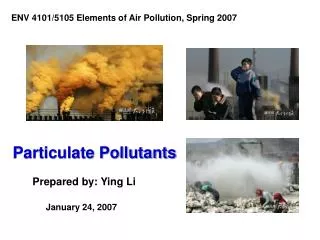
Air pollutants, classified as criteria pollutants, include sulfur dioxide, nitrogen oxides, carbon monoxide, particulate matter, ozone, lead, and volatile organic compounds. These substances arise primarily from industrial activities, burning fossil fuels, and vehicle emissions. Sulfur dioxide, a colorless gas with a distinct smell, contributes to acid rain, while nitrogen oxides form smog when combined with sunlight. Carbon monoxide is a highly toxic gas affecting oxygen transport in the blood. Addressing these pollutants is critical for air quality and public health.

Understanding Major Air Pollutants and Their Environmental Impact
E N D
Presentation Transcript
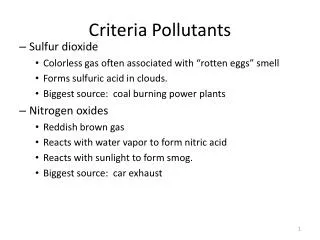
Criteria Pollutants • Sulfur dioxide • Colorless gas often associated with “rotten eggs” smell • Forms sulfuric acid in clouds. • Biggest source: coal burning power plants • Nitrogen oxides • Reddish brown gas • Reacts with water vapor to form nitric acid • Reacts with sunlight to form smog. • Biggest source: car exhaust
Criteria Pollutants • Carbon Monoxide • Colorless, odorless, highly toxic gas • Binds to hemoglobin in red blood cells, interfering with oxygen transport • Biggest source: car exhaust • Particulate Matter • Dust, ash, soot, lint, smoke, pollen, spores, and all other suspended matter. • Cause the most visibility problems • Biggest source: unpaved road dust and construction
Criteria Pollutants • Ozone • Molecule made of three oxygen atoms • Pale blue gas, odor resembling chlorine bleach • Secondary pollutant; not released directly • Lead • Enters the air as particles or part of dust. • The biggest source used to be exhaust from cars using leaded gas; now it is industry and burning fossil fuels.
Clean Air Act • The Clean Air Act was amended in 1990 and included additional provisions and controls for: • Acid Rain • Urban Smog • Toxic and Hazardous Air Pollutants • Protection of the Ozone Layer • Leakage of volatile organic compounds
Other Major Pollutants • Volatile organic compounds • Organic (carbon-based) gases like methane that can decompose or react easily, forming carbon dioxide or carbon monoxide in the air. • Biggest sources: • Spilled/leaking gasoline that evaporates • Paint and paint cleaners
Acid Deposition • Acid Precipitation – Rainfall or snowfall that contains an lower than normal pH. • pH scale ranges from 0-14. • 7 = Neutral; <7 = Acidic; >7 = Basic • Unpolluted rain generally has pH of 5.6. • Carbonic acid from atmospheric CO2. • In industrialized areas, the pH level can reach as low as 4.3 • Rain of pH 2.1 was recorded in the 1970s and 1980s