Calculating Net Force and Acceleration Using Newton's Second Law
This chapter provides practice problems focused on applying Newton's Second Law to determine net force on accelerating objects. Key examples include calculating the force required to accelerate a 1500 kg race car at 3.00 m/s², finding the force on a 55 kg artillery shell fired from a gun, calculating the weight of a 2.26 kg bag of sugar, and determining the coefficient of friction for a block on a tabletop. Each problem is solved step-by-step, reinforcing the fundamental principles of dynamics.

Calculating Net Force and Acceleration Using Newton's Second Law
E N D
Presentation Transcript
Chapter 5 Practice problems Net Force
Sample #1 • Using Newton’s Second Law to find the net force on an accelerating object: • …. What net force is required to accelerate a 1500 kg race car act at +3.00m/s2?
Sample #1 • Given: m = 1500 kg a =+ 3.00 m/s2 • Unknown: Force, F
Sample #1 • Basic equation: • F = ma
Sample #1 • Answer: 4500 N force
Sample #2 • Finding force when acceleration must be calculated:
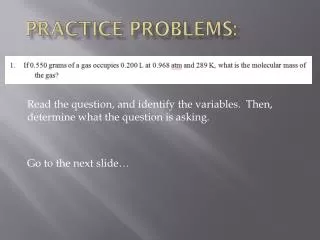
Sample #2 • An artillery shell has a mass of 55 kg. The shell is fired from a gun leaving the barrel with a velocity of + 770 m/s. The gun barrel is 1.5 m long. Assume that the force, and thus the acceleration is constant while in gun barrel. What is the force on the shell while it is in the gun barrel?
Sample #2 • Given: M = 55 kg vf = + 770 m/s vi = 0 m/s • D = +1.5 m • Unknown: force, F • Basic equations: F = ma • Vf2 =vi2 + 2ad
Sample #2 • Answer: 1.1 X 10⁷ N
Sample # 2 • Solution: = • A = (+770m/s2) - 0 • 2(1.5 m) • a = +2.0 X 10⁵ m/s2 ( in the direction of the velocity) • F = 55 kg +2.0 X 10⁵ m/s2
Sample #3 • Calculating weight: • Find the weight of a 2.26 kg bag of sugar
Sample #3 • g= 9.8 m/s2 • Equation: W = mg
Sample #3 • Answer : 22.1 N
Sample #4 • Sliding friction: • A smooth wooden block is placed on a smooth wooden tabletop. You find that you must exert a force of 14.0 N to keep the 40.0 N block moving at a constant velocity
Sample #4 • A. What is the coefficient of friction for the block and table? • Given: FA = 14 N W = 40 N a = 0 • Unknown : Coefficient of friction = μ
Sample #4 • Basic equation = F= ma Ff =FμFN
Sample #4 • Because a = 0 the force you exert, FA must be equal to Ff