Download
1 / 18
330 likes | 965 Views
Modal verbs are essential in English for expressing ability, necessity, possibility, and advice. This guide covers key modal verbs—CAN, COULD, MUST, MAY, MIGHT, SHOULD, and HAVE TO—highlighting their characteristics, usage, and meanings. Learn about present, past, and future abilities, positive and negative certainties, obligations, and forms of advice. Understand how to correctly structure sentences with modal verbs, avoiding common errors like using "do" in negatives and questions. Strengthen your understanding of modal verbs to enhance your English communication skills.

E N D
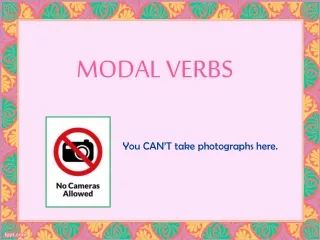
MODAL VERBS You CAN’T takephotographshere.
SOME CHARACTERISTICS • Theverbs: • CAN • COULD • BE ABLE TO • MAY • MIGHT • MUST • HAVE TO • SHOULD are MODAL AUXILIARY VERBS.
SOME CHARACTERISTICS MODAL VERBS are used in EnglishtoHELPotherverbsexpress: Ability Possibility Certainty Advice Obligation / Necessity Lack of necessity Prohibition
SOME CHARACTERISTICS They do nottakean –s / -ing / -edendingHe can cook(NOT: He canscook). They do not use theauxiliary “do” toformquestions and negatives Theyshouldn’tmakeanynoise(NOT: Theydon’tshouldmakeanynoise). They are followedbythe BASE FORM of the VERB You MUST FASTEN yourseat-belt(NOT: You MUST TO FASTEN yourseat-belt). They do notform ALL TENSES. Theyusuallyhave PRESENT or PAST tense He CAN playtennis / He COULD playtenniswhen he was 5 yearsold.
ABILITY • PRESENT ABILITY – CAN • Meaning“poder fer algo” / “saber fer algo” Peter CAN READ but his sister Rose, CAN’T.
ABILITY • PAST ABILITY – COULD • Meaning “podiafer algo” / “sabia fer algo” Mrs Turner COULD PLAY tennis before she had the accident.
ABILITY • FUTURE ABILITY – WILL BE ABLE TO • Meaning “podré fer algo” / “sabré fer algo” Doctors WILL BE ABLE TO FIND a cure for cancer.
POSITIVE CERTAINTY • MUST • Meaning “definitely yes” / “I’msure” He MUST BE lost!
POSSIBILITY • MAY / MIGHT / COULD • Meaning “itispossible” / “perhaps” • Why is the baby crying? • He MAY / MIGHT / COULD BE hungry!
NEGATIVE CERTAINTY • CAN’T • Meaning “definitelynot” / “I’msurenot” He CAN’T BE at home!
ADVICE • POSITIVE ADVICE – SHOULD • NEGATIVE ADVICE – SHOULDN’T • Meaning “I adviseyouto / notto” (“t’aconsello que / que no) You SHOULD BE more careful!!
OBLIGATION / NECESSITY • There are 2 types of necessity / obligation: • INTERNAL - The speaker decides that something is necessary; some personal circumstances make the obligation necessary. • EXTERNAL - Somebody else other than the speaker has made the decision; some external circumstances make the obligation necessary (laws, regulations, agreements and other people’s orders).
INTERNAL OBLIGATION / NECESSITY • MUST / HAVE TO • Meaning “it is necessary” / “I’m obliged to” You MUST LISTEN to me carefully! You HAVE TO LISTEN to me carefully!
EXTERNAL OBLIGATION / NECESSITY • HAVE TO • Meaning “it is necessary” / “I’m obliged to” I HAVE TO WEAR a uniformeveryday at work.
OBLIGATION / DUTY • 3rd PersonObligation – MUST • Itismainlyused in WRITTEN: • Orders • Rules • Instructions • Meaning “it is obligatory to”
LACK OF OBLIGATION / NECESSITY • DON’T / DOESN’T HAVE TO • (don’t/doesn’tneedto & needn’t) • Meaning “it isn’t necessary to do something” The farmer DOESN’T HAVE TO BUY any vegetables (= It isn’t necessary for the farmer to buy any vegetables)
PROHIBITION • MUSTN’T • Meaning “it is forbidden to do something” / “you are not allowed to do something” /”it is against the rules” /”youcan’t do something”