Cell Respiration
Cellular respiration is a multi-step process that breaks down food to release energy in the presence of oxygen. This process begins with glycolysis, where one molecule of glucose is split into two molecules of pyruvic acid, yielding a net gain of 2 ATP. If oxygen is present, pyruvic acid enters the Krebs cycle and the electron transport chain, producing CO2 and more energy. In the absence of oxygen, fermentation occurs, resulting in lactic acid or alcohol. Overall, the gradual release of energy is efficient, facilitating life-sustaining processes in cells.

Cell Respiration
E N D
Presentation Transcript
Cell Energy Chemical energy and food • one gram of glucose (C6H12O6) when burned in the presence of oxygen, releases ______ calories of heat energy • 3811 calories • calorie – amount of energy needed to raise the temperature of 1 gram of water 1 Celsius degree
Cell Energy Chemical energy and food • cells don’t “burn” glucose. • instead, they gradually release the energy from glucose and other food compounds. • this process begins with a pathway called? • glycolysis
Cell Energy Glycolysis • releases only a small amount of energy • if oxygen is present, glycolysis leads to two other pathways that release a great deal of energy • if oxygen is not present, glycolysis is followed by a different pathway
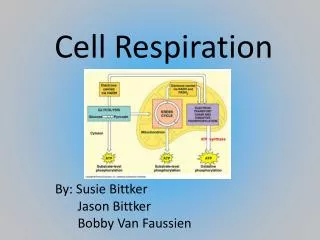
Cell Energy Cellular Respiration glucose Electron Transport chain Kreb cycle glycolysis lactic acid or alcohol Fermentation (in absence of oxygen)
Cell Energy Cellular Respiration • in the presence of oxygen, glycolysis is followed by the • Krebs cycle • Electron transport chain • these steps make up a process called cellular respiration
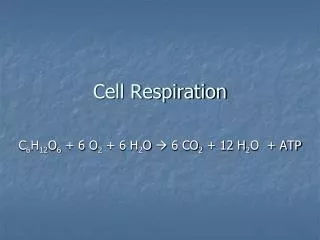
Cell Energy Cellular Respiration • the process that releases energy by breaking down food molecules in the presence of oxygen 6O2 + C6H12O6 6CO2 + 6 H2O + energy oxygen + glucose carbon dioxide + water + energy
Cell Energy Energy? • if cellular respiration took place in one step, all of the energy of glucose would be released at once • most of it being in the form of light and heat • instead, the cell releases the energy a little bit at a time • these little bundles of energy are used to make ATP
Cell Energy Energy? • How much ATP? • A working muscle cell converts ADP into ATP at a rate of about 10 million per second
Cell Energy Cellular Respiration Electrons carried by NADH Pyruvic acid electron transport chain Kreb cycle glycolysis glucose (cytoplasm) (mitochondrion)
Cell Energy Glycolysis • process in which one molecule of ________ is broken in half
Cell Energy Glycolysis • process in which one molecule of glucose is broken in half • producing two molecules of _______ ____
Cell Energy Glycolysis • process in which one molecule of glucose is broken in half • producing two molecules of pyruvic acid • a 3-carbon compound
Cell Energy Glycolysis - ATP • even though glycolysis is an energy-releasing process, the cell needs to put in a little energy to get things going. • as process begins – 2 ATP molecules are used up • when complete, 4 ATP molecules have been produced • resulting in a net gain of ______
Cell Energy Glycolysis - ATP • even though glycolysis is an energy-releasing process, the cell needs to put in a little energy to get things going. • as process begins – 2 ATP molecules are used up • when complete, 4 ATP molecules have been produced • resulting in a net gain of 2 ATP
Cell Energy Glycolysis - NADH • one reaction of glycolysis removes 4 high-energy electrons and passes them on to an electron carrier (similar to photosynthesis) • electron carrier – NAD+ • this carrier holds the electrons until they can be transferred to other molecules
Cell Energy Glycolysis - Energy • although the energy yield from glycolysis is small, the process is so fast that cells can produce thousands of ATP molecules in just a few milliseconds • problem – in a few seconds, all the NAD+ molecules are filled with electrons. • result – ATP production stops
Cell Energy Glycolysis glucose pyruvic acid To the electron transport chain
Cell Energy Fermentation • releases energy from food molecules in the absence of oxygen • anaerobic process – does not require oxygen • two main types of fermentation • Alcoholic • Lactic acid
Cell Energy Alcoholic Fermentation • occurs in yeast and a few other microorganisms • forms ethyl alcohol and carbon dioxide as wastes pyruvic acid + NADH alcohol + CO2 + NAD+
Cell Energy Lactic Acid Fermentation pyruvic acid + NADH lactic acid + NAD+ • occurs in your muscles during rapid exercise when the body cannot supply enough oxygen to the tissues. • build up of lactic acid in muscles is what causes painful, burning sensation and eventually muscle fatigue
Cell Energy Glycolosis • at the end of this first step of cellular respiration 90 percent of the chemical energy that was available in glucose is still unused – locked in the high-energy electrons of pyruvic acid. • oxygen • powerful electron acceptor • required for rest of cellular respiration • this makes it an aerobic process
Cell Energy The Krebs Cycle • general summary of reactions • pyruvic acid is broken down into carbon dioxide in a series of energy extracting reactions • two main reactions • citric acid production • energy extraction
Cell Energy The Krebs Cycle • Citric acid production • pyruvic acid enters the mitochondria • one C bonds with O to become CO2 and is released • 2 remaining C’s used to form acetyl-CoA • acetyl-CoA is added to a 4-C molecule to form citric acid
Cell Energy The Krebs Cycle Citric acid production
Cell Energy The Krebs Cycle • energy extraction • in stages, the 6-C citric acid is converted to a 4-C molecule • during this process the following occurs • 5 pairs of high-energy electrons are captured by 5 carrier molecules (NADH & FADH2) • CO2 and ATP produced
Cell Energy The Krebs Cycle Energy extraction
Cell Energy Electron Transport Chain • general summary of reaction • electron transport chain uses high-energy electrons from Krebs cycle to convert ADP into ATP • it is divided into 3 steps • electron transport • hydrogen ion movement • ATP production
Cell Energy Electron Transport • electron transport • high-energy electrons from NADH and FADH2 are passed along the chain • oxygen serves as the final electron acceptor in the chain • hydrogen ion movement • energy from 2 high-energy electrons is used to transport hydrogen ions (H+) • this eventually results in a slight positive charge inside the membrane and a slight negative charge outside the membrane
Cell Energy Electron Transport • ATP production • inner membrane contains protein spheres called ATP synthase • charge difference between inside and outside causes H+ to escape through these proteins • as H+ escapes it causes part of protein to spin • this spinning creates ATP from ADP • on average each pair of high-energy electrons produces 3 ATP molecules
Cell Energy Electron Transport
Cell Energy How much energy from glucose? • glycolysis 2 ATP net • fermentation 0 ATP (when no oxygen present) Total 2 ATP
Cell Energy How much energy from glucose? • glycolysis 2 ATP net • Krebs cycle and Electron transport chain 34 ATP (in presence of oxygen) TOTAL 36 ATP • This amount of ATP is roughly 38% of total energy in a glucose molecule. • The remaining 62% is released as heat.
Cell Energy Photosynthesis and Cellular Respiration • turn to page 232, Figure 9-10 • what is similar about these reactions? • the reactants of one reaction are the products of the other