Download
1 / 5
50 likes | 206 Views
This document outlines strategies for supporting speech and language development in children as part of the Partnership Development Schools (PDS) Strategy Phase 3 (2008-09). Effective communication is essential for social, educational, and emotional well-being. The text discusses various classroom strategies like breaking down spoken language into manageable parts, using visual aids, and reinforcing key vocabulary. Additionally, it emphasizes the importance of creating an environment that fosters effective communication for children struggling with language. For more details, contact Chris Ley at The Park Community School.

E N D
Inclusion Speech and Language Produced as part of the Partnership Development Schools (PDS) Strategy Phase 3 2008-09 (Lead PDS: The Park Community School. Contact Chris Ley (cley@parkcommunity.devon.sch.uk)
‘Children who are unable to communicate effectively through language or to use language as a basis for further learning are handicapped socially, educationally and as a consequence, emotionally.Byers-Brown and Edwards 1989
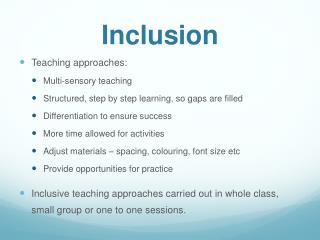
Strategies within the Classroom Where is the child seated? Break spoken language down into chunks. Use visual reinforcement for spoken instructions. List key topic vocabulary and over teach it. Mind map. Get the student to say the information back to you. Less is more when explaining. Help record homework carefully.