Enhancing Pre-College Math: From Professional Development to Learning Communities
This initiative focuses on transforming pre-college mathematics education by emphasizing curricular change, intentional instructional strategies, and high-quality assessments to boost student engagement and understanding. Key strategies include fostering collaborative inquiry among faculty, examining educational practices, and utilizing faculty inquiry groups. By engaging teachers in reflective practices and community support, we aim to link student success with the quality of their learning experiences, ultimately leading to improved outcomes in mathematics.

Enhancing Pre-College Math: From Professional Development to Learning Communities
E N D
Presentation Transcript
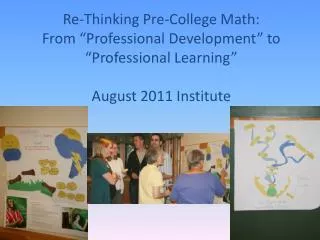
Re-Thinking Pre-College Math:From “Professional Development” to “Professional Learning”August 2011 Institute
Improving Student Learning in Math:Core Educational Practice Achieving our goals of increasing student engagement in math and deepening their mathematical understanding, involves 1) curricular change, 2) more reflective and intentional instruction, and 3) more focused and higher-quality assessments. You need to address all three areas but the real levers of change in student learning are the latter two… Faculty support through professional “community of practice”
KeyElements of RPM Project • Shared understandings and collective responsibilities • Collaborative inquiry and “empirical tinkering” focused on core areas of educational practice • Targeted focus on increasing student engagement and improving mathematical understanding • Exploration of beliefs and professional identities
Logic Model • Student success in precollege math is directly linked to their experiences in math classes, and students who experience more engaging, relevant learning are more likely to succeed. • Groups of teachers can improve student success in precollege math courses if they are supported in examining assessment, curriculum and pedagogical practices and if they are invited to use faculty inquiry groups informed by classroom exchanges and formative classroom assessment techniques. • The three core practices in the project—CATs, classroom exchanges, and faculty inquiry groups--are intended to help build the capacity of individual teachers, groups of teachers, and ultimately departments, to think critically about the relationship between teaching practices and student learning, with the goal of changing teaching practices in ways that increase student learning.
Student Success/ achievement Logic Model: Rethinking Pre-College Math Department/ Program Faculty Inquiry Groups • Classroom Assessments • Classroom Exchanges COMMON PRACTICES Program assets/ College context