4rd Implementation Report
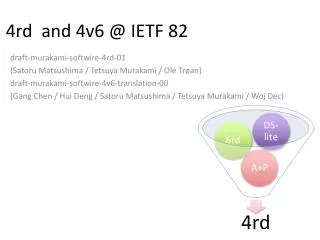
This report details the implementation of 4rd (Fourth Revolution in Domain) logical functions focused on the translation from IPv4 to IPv6. Presented by Bing Liu, Sheng Jiang, and Yu Fu at IETF 84 in Vancouver on August 2, 2012, it discusses the functionality of translation Customer Premises Equipment (CPE). Key points include the lightweight nature of 4rd packet translation, compliance with standard IP protocols, and the seamless integration with TCP/IP stacks. The report asserts that the implementation does not require protocol-specific extensions, enhancing efficiency and maintaining compatibility.

4rd Implementation Report
E N D
Presentation Transcript
4rd Implementation Report Bing Liu(speaker), Sheng Jiang, Yu Fu @softwire-IETF 84-Vancouver Aug-2 2012
4rd logical functions (CPE) 6->4 translation CPE CPE 端口限制 NAT44 4o6报文解/封装 NAT44翻译 FragmtHdr Port restrict IPv4 Forwarding 4->6 translation IPv4 Fragmt Identifying 4rd packets IPv4host IPv4/IPv6判断模块 IPv6 only FragmtHdr IPv4转发模块 Addr Calculation Mapping rule table 4rd BR IPv6转发模块 IPv6 forwarding IPv6host
4rd logical functions (BR) 6->4 IPv4 FWD FragHdr IPv4Internet Mapping rule table Addr Calculation 4->6 IPv4 Fragmt FragHdr Identififying 4rd packets IPv6 only CPE IPv6FWD IPv6Internet
Implementation in Linux Linux Kernel TCP/IP Stack Linux Kernel Netfilter 4RD Translator 4RD Virtual Interface CPE LAN Interface CPE WAN Interface 4rd module
Preliminary Conclusions • 4rd doesn’t change any IP protocol standards at the routing plane. • At the routing plane, 4rd packet is identical to normal IPv6 packet. Since we only used standard interfaces to input/output packets to/from the 4rd module, the TCP/IP stack itself doesn’t need to do 4rd-specific extension. • The 4rd fragment header remains the same data structure of IPv6 standard, the utilization of fragment-header doesn’t bother the TCP/IP stack and routers, unless fraghdr-specific-rules DPI is deployed. • 4rd packet translation is lightweight • No need to deal with the checksum adjustment(benefit from CNP) • No need to process each protocol (TCP/UDP/ICMP) respectively • More likely an “encapuslation” rather than “translation” • Our implementation and analysis haven’t identified any ambiguity or flaw.
Thank you!leo.liubing@huawei.comjiangsheng@huawei.com eleven.fuyu@huawei.comAug 2, @Vancouver